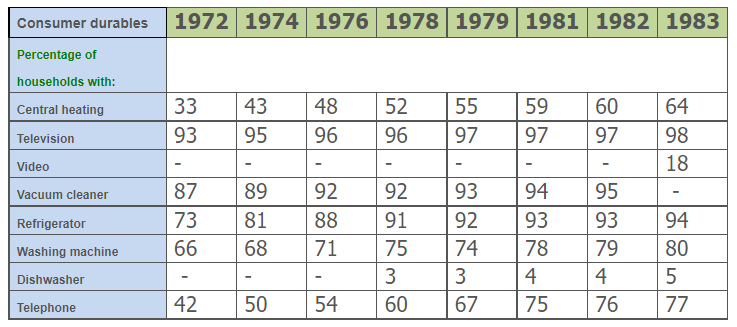
The table below shows the consumer durables (telephone, refrigerator, etc.) owned in Britain from 1972 to 1983.
Sample Response
The table data represents information about the percentage of British households that had consumer products like TV, refrigerators, washing machines, telephones and so on between 1972 and 1983.
Generally speaking, the most common consumer electronic item in Britain was televisions, whereas the least households owned dishwashers and video players.
As the data suggests, TVs and vacuum cleaners were highly popular in English families with their ownership percentages of 93 and 87 respectively in 1972. A similar ownership pattern for refrigerators and washing machines denotes their popularity during the period as well. Other household appliance ownership by English families increased during the given period and this rising trend was more significant for telephone and central heating machines. Videos were introduced in 1983, and only 18% of British families had them back then. A similar trend could be observed for the dishwashers – though they appeared in 1978, not more than 5% of British families possessed them in 1983
IELTS Writing Correction
- 1. Use table term consumer durables such as televisions, refrigerators, washing machines, and telephones
- 2. Category accuracy consumer durable
- 3. Fewest households the fewest households owned
- 4. Use table label video recorders
- 5. Use accurate population British households
- 6. Add percent sign with ownership rates of 93% and 87%, respectively
- 7. Natural verb shows that they were also popular
- 8. Awkward noun stack Ownership of other household appliances
IELTS Writing Criteria Scores
Detailed feedback by IELTS writing criterion after the annotated essay.
Task Achievement
The response gives a clear overview of high- and low-ownership items and mentions several important trends. It misses some precise end-point figures and says vacuum cleaners were highly popular without noting the missing 1983 value in the table.
Add exact start-end comparisons for central heating, telephones, refrigerators, and washing machines, and be careful with missing data.
Coherence and Cohesion
The paragraphing is clear, but the detail paragraph tries to cover all items at once and the final sentence lacks a full stop. The progression would be stronger with grouped comparisons.
Group high-ownership items together, then discuss newer or less common items such as videos and dishwashers.
Lexical Resource
Vocabulary is adequate, but 'consumer electronic item', 'machines', and 'English families' are not fully accurate for the table.
Use 'consumer durables', 'British households', 'ownership', 'rose', and 'remained widespread'.
Grammatical Range and Accuracy
There are some article and sentence-boundary problems, but the message remains clear. Several noun phrases could be more precise.
Check plural nouns and finish every sentence with correct punctuation.