All tasks 26Academic Task 1 10General Training Task 1 4Task 2 12
Official Band
All Bands 267.5 17.0 36.5 66.0 95.5 45.0 3
01
Cambridge IELTS 18 · Academic Test 1 · Task 1
Academic · Task 1
Band6.0
Words
163
Type
Academic Task 1
Full task question
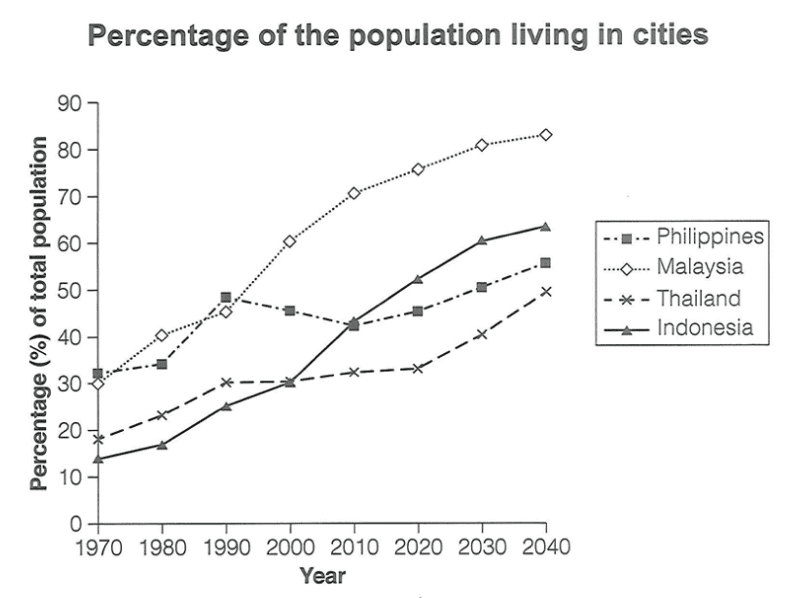
The graph below gives information about the percentage of the population in four Asian countries living in cities from 1970 to 2020, with predictions for 2030 and 2040.
Summarise the information by selecting and reporting the main features, and make comparisons where relevant.
Write at least 150 words.
Full candidate response
The line graph illustrates the proportion of urban citizens in Philippines, Malaysia, Thailand and Indonesia between 1970 and 2020, with the expected population in 2030 and 2040.
Overall, it can be easily seen that all four countries has a dramatic rise in population, starting at the lowest point in 1970 and being projected to reach the peak in 2040.
Malaysia and Indonesia saw a slightly rise in population, respectively from 30 to about 45 and around 12 to over 20 percent from 1970 to 1990. After that, both countries has climbed rapidly until now before being predicted to continue increasing for the next 20 years.
After almost remaining in the 70s, Philippines percentage increased dramatically to reach about 47 percent on 1990 and dropped to 40% in 2010. Then, this country faced slightly rise in 2020.
Meanwhile, Thailand reached approximate 30% in 1990 and saw not much changes until 2020. Both two countries are projected to increase in population in 2030 and 2040.
Full official examiner comment
This response covers the requirements of the task. There is an overview in the second paragraph and key features are presented for each country, with main trends identified. Ideas are grouped together with a clear overall progression: countries with a similar trend are presented in the same paragraph, first Malaysia and Indonesia, then Thailand and the Philippines. There is some effective use of linkers [Overall | After that | Meanwhile] and other cohesive devices [respectively | this country], but a few errors remain [Both two]. Vocabulary includes a range, with some less common examples [proportion | expected population | dramatic rise | projected to reach the peak]. There are some errors [slightly I slight | almost remaining | approximate / approximately], which do not impede communication. The mix of grammatical structures is good, with some complex sentence forms [being predicted to continue increasing for the next 20 years]. Some errors remain, but they rarely reduce communication. To improve the Band Score for this response, there could be more detail on the similarity of the trends on the graph, more detail on data from 1990 onwards and fewer errors in spelling and grammar. However, this is a good response that does address the requirements of the task.
02
Cambridge IELTS 18 · Academic Test 2 · Task 1
Academic · Task 1
Band5.5
Words
145
Type
Academic Task 1
Full task question
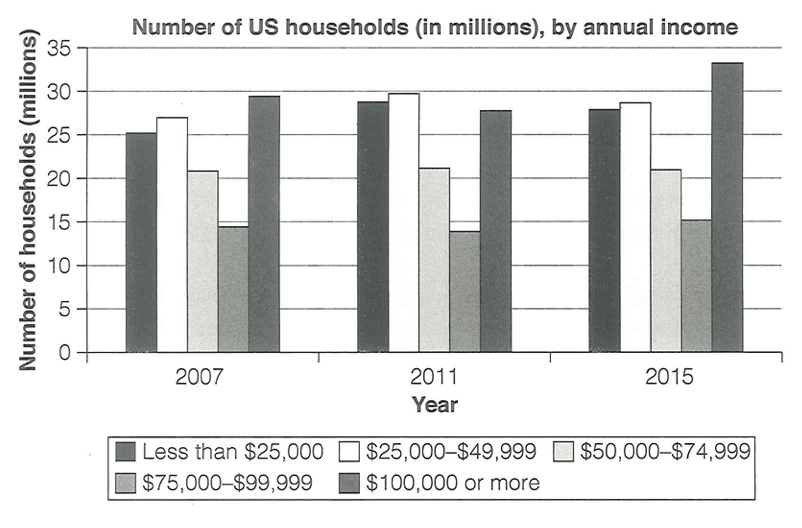
The chart below shows the number of households in the US by their annual income in 2007, 2011 and 2015.
Summarise the information by selecting and reporting the main features, and make comparisons where relevant.
Write at least 150 words.
Full candidate response
The graph illustrats the data of different levels of annual wage of families in the united states in 2007, 2011 and 2015.
As far as the number of families whose annual income was less than $25,000, it began with around >5 million in 2007, then increased to approximately 27 million in 2011, but decreased by 2 million 4 years later. Similarly, those of families that earned $25,000 to $49,999 were about 25 million in 2007, after that it rose to nearly 30 million in 2011. Finally it decreased to around 27 million in 2015.
By contrast, the groups of families which have high income, including $75,000 to $99.999 and $100,000 or more, experienced a drop in 2011, but their data went up in 2015.
Interesting things could be seen in the group of middle income, the data remain the same in 2007, 2011 and 2015.
Full official examiner comment
This response does present most of the data within the bar chart and the key features required. To improve the response, an overview of the information should be included, for example: Across the 8 years, households with incomes below $50,000 rose, then fell back slightly, households with incomes of over $75,000 fell slightly then increased and those with the mid-level incomes remained the same. The information is arranged coherently, starting with the details for the lower-income households, then the higher, then the mid-section. There are some effective cohesive devices [As far as Similarly By contrast]. The vocabulary is suitable for the task, but there is an error [>5 million / 25 million] which is not helpful when reporting the details. There is a mix of simple and complex structures, with sentences that contain multiple clauses. There are some examples of missing capitalisation [united states / United States] with some errors [remain I remained]. To improve the response, it is important to re-read to check for small errors with vocabulary and to include an overview or summary of the salient information.
03
Cambridge IELTS 19 · Academic Test 1 · Task 1
Academic · Task 1
Band6.5
Words
229
Type
Academic Task 1
Full task question
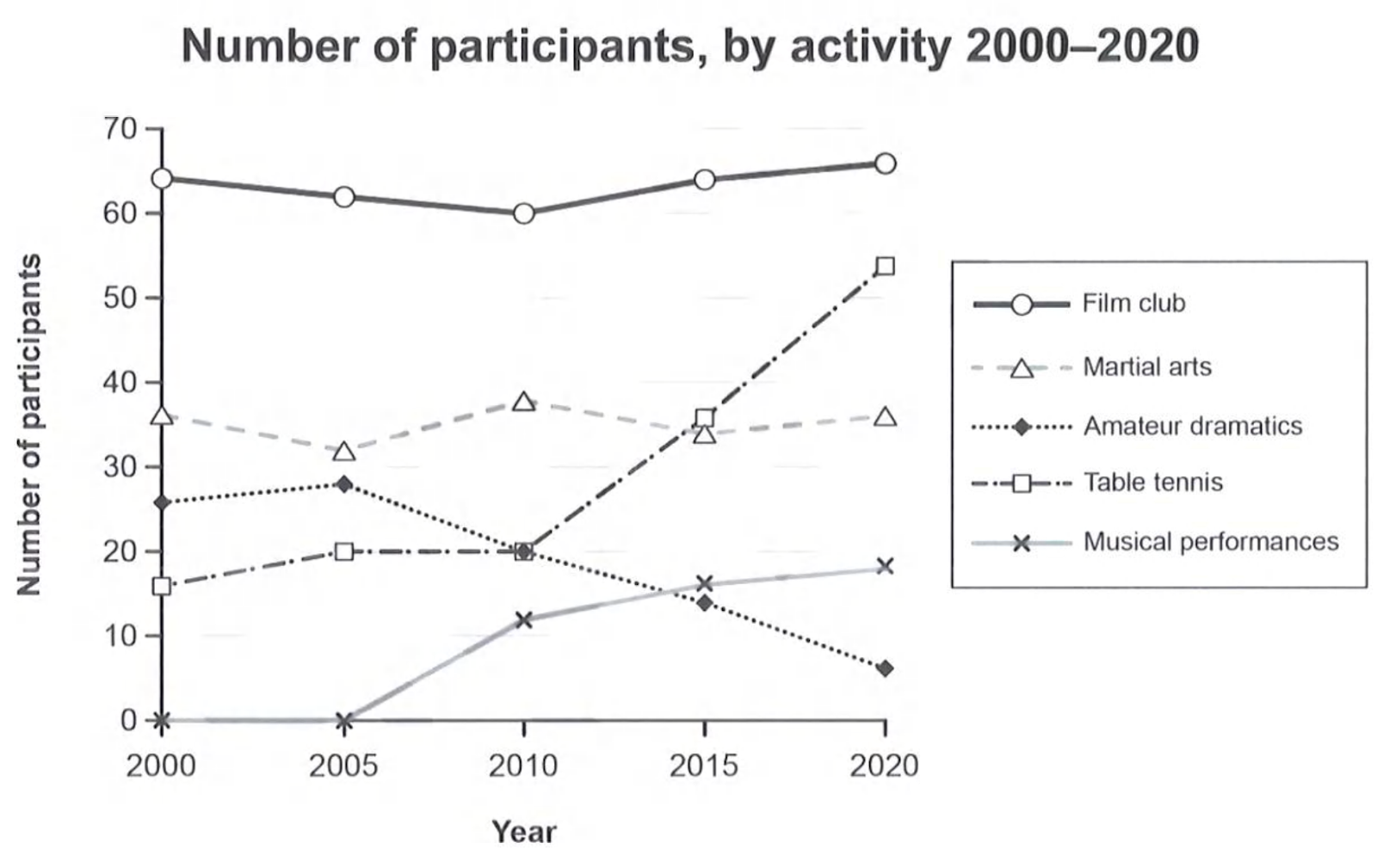
The graph below gives information on the numbers of participants for different activities at one social centre in Melbourne, Australia for the period 2000 to 2020.
Summarise the information by selecting and reporting the main features, and make comparisons where relevant.
Write at least 150 words.
Number of participants, by activity 2000-2020
Full candidate response
The line graph highlights data about how many people participated in 5 various activities at one social club in Melbourne, Australia for the first two decades of XXI century.
Overall, over the years more participants got involved in activities on Table tennis and Musical plays, while Amateur dramatics lost its interest for public. Being flactuated, two types of activities, which are Film club and Martial arts levelled off. Another striking point is that over a twenty – year period between 2000 and 2020, the Film club kept its position as the most popular activity.
Looking at the details of Table tennis, in 2000, there were about 15 participants in club for it. In the next 10 years, it attracted 5 more members, before dramatic surge from 20 to below 60 participants. In 2005, the activity on Musical performances introduced and over the following 15 years, it saw a steady increase on the number of participants by about 20 in the last year.
Regarding next two activities, Film club and Martial arts, the saw fluactions, but without any changes in the overall position. Film club started the process with about 60 members and finished it just below 70, while the participants of Martial arts kept their numbers at around 35.
The number of participants of amateurs on draturgy was about 25 and it saw a steady decrease then by 10.
Full official examiner comment
This good response begins with an introduction, then in the second paragraph summarises the main trends. The next few paragraphs contain the data and cover each of the participant groups. The information is organised logically and a range of linking devices are used [Overall | Another striking point | In the next 10 years]. There is also some flexible reference and substitution [while | which | it | their] with a few inaccuracies. Vocabulary is generally good [got involved in | levelled off | dramatic surge], but there are some errors [flactuated / fluctuated | amateurs on draturgy / amateur dramatics]. This response has a variety of grammatical structures and the past simple tense is well controlled. There are sentences with multiple clauses, including superlatives (most popular], but also some errors in verb forms [introduced / was introduced], some missing articles [public / the public | dramatic surge / a dramatic surge | next two / the next two], some errors with prepositions [in club for it / in the club | by about 20 / to about 20] and inconsistent capitalisation. The candidate should demonstrate a greater level of accuracy with grammatical structures.
04
Cambridge IELTS 19 · Academic Test 1 · Task 2
Academic · Task 2
Band6.0
Words
257
Type
Task 2 essay
Full task question
Some people think that competition at work, at school and in daily life is a good thing. Others believe that we should try to cooperate more, rather than competing against each other.
Discuss both these views and give your own opinion.
Give reasons for your answer and include any relevant examples from your own knowledge or experience.
Write at least 250 words.
Full candidate response
In my opinion competition at work, at school and in daily life can both be a good thing and a bad thing. Why? because I think too much of anything can be destructive. Yes, it’s a very good thing to be competitive but don’t overdo it! Having no competition in your life at all can be very depressing, because you have no motivation, no goals you want to achieve, everytime you wake up in the morning. I don’t believe that there is such thing as “co-operating” too much, when you work with someone you should work together as a team and co-operate, but also do things for yourself, like something career-wise. You should think of your future in your work. That goes the same if you are still in school, take my school life for example. If I am very good at one subject in particular, lots of other student may come up to me and ask for pointers. I would be very glad to help them. If there is any homework, school mates may come over to do it together. this is also fine and very good for building relationship. But sometimes there are people who think you are so nice and ask you to do their work for them. This is where you should draw the line, yes you are friends and you should help each other, but that doesn’t mean that you have to do their homework or give them answer when there is a test. Remember life is a competition, be a winner.
Full official examiner comment
This response covers the task and is engaging to read. The candidate starts by saying competition can be good and bad, too much can be [destructive] and too little can be [depressing] as you would have [no motivation, no goals]. No specific examples are given, and they would improve the response. The rest of the response addresses ‘cooperation’ but is mostly about how people can cooperate rather than comparing ‘cooperation’ with ‘competition’ in line with the question. The conclusion [… be a winner] slightly contradicts the earlier point [/ don’t believe that there is such a thing as “co-operating” too much]. Unfortunately, there is no paragraphing to group ideas together or indicate main topics. This affects the rating for coherence and cohesion. There is some higher-level vocabulary [destructive | motivation | career-wise] with some idiomatic use [draw the line] which makes vocabulary the strongest area in this response. A wider range would be needed for a higher score. There is a range of grammatical structures, including comparative forms and conditional [if) structures. Although they do address the task and present relevant ideas, to achieve a higher score, the candidate should organise the response into paragraphs and discuss both views. They could also demonstrate a greater level of accuracy with vocabulary and grammatical structures.
05
Cambridge IELTS 19 · Academic Test 2 · Task 1
Academic · Task 1
Band6.5
Words
228
Type
Academic Task 1
Full task question
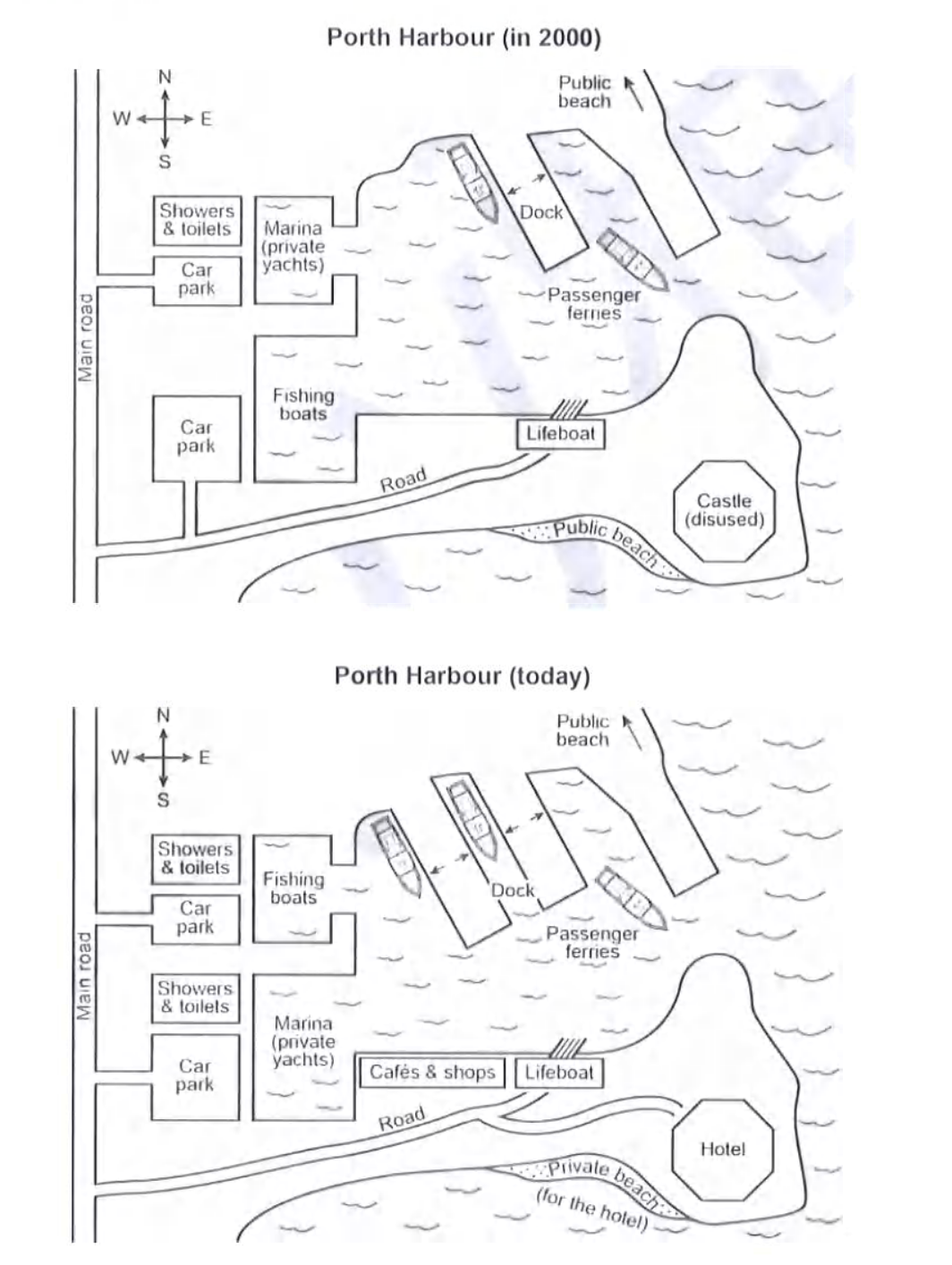
The plans below show a harbour in 2000 and how it looks today.
Summarise the information by selecting and reporting the main features, and make comparisons where relevant.
Write at least 150 words.
Full candidate response
The maps give the information about the improvement of the Porth Harbour from 2000 to today.
The first impression is that the Harbour today made use of more areas than in the past.
It can be seen that there are several areas that still stay the same today as in 2000. These include the Carpark and the Showers and Toilets which are located in the north west of the map. However, one more Showers and Toilets are built between the two Carpark today. Besides, the Porth Harbour today also has one more Passenger ferries which right next to the left of the existing one from 2000. Moreover, an area for Cafés and shops is added next to the Lifeboat one. Another significant difference is the relocation of the Marina (private yachts) and the fishing boats areas. Today, the Marina is moved down to the place of the old Fishing boats area to have more space and vice-versa, the Fishing boats area is relocated at the old Marina area. The last noticeable change in this Harbour is the Construction in the South East. The disused old Castle was destroyed and a new Hotel was built there today and another Hotel Is also added in the Private beach area.
Overall, even that the harbour still keeps some areas unchanged, there are many reconstructions and improvements for the Porth Harbour today.
Full official examiner comment
Overall, this is a strong response. The candidate has covered the main features of the changes and has included an overview to summarise the changes, in the first and the last paragraph. The main details are accurate, apart from the addition of [another Hotel) in the private beach area. The reader can follow the ideas as they are logically organised. This is due to the linking words [However | Besides | also | Another | Overall] and cohesive features [existing one | vice-versa], but there are some errors. Vocabulary demonstrates some flexibility [first impression | relocated | noticeable change], but there is also some inaccuracy and repetition. The weakest area, though, is the use of grammatical structures. There is a mix of sentence forms, with some good complex use [made use of | can be seen that | These include … which are] but some errors, such as inaccurate use of the plural [one more Showers | boats areas] (because the candidate has copied the plural form from the question) and incorrect verb form [is moved down | has been moved down]. To achieve a higher score, the candidate should present an overview to summarise the main stages, for example: The changes to the harbour between 2000 and now focus on improvements that are targeted towards attracting visitors or tourists to the harbour, and include a new hotel, with private beach, more capacity for the passenger ferries and expanded facilities.
06
Cambridge IELTS 19 · Academic Test 2 · Task 2
Academic · Task 2
Band6.0
Words
319
Type
Task 2 essay
Full task question
The working week should be shorter and workers should have a longer weekend.
Do you agree or disagree?
Give reasons for your answer and include any relevant examples from your own knowledge or experience.
Write at least 250 words.
Full candidate response
I personally disagree with the issue whether the working days should be one day less. By no means should we make the weekend three days long. There are two aspects that support my point of view.
First of all, now all over the world are facing an unprecedented economic recession caused by COVID-19. Many factories are forced to close and the shops shut down. The economic loss is substantial. Nevertheless, with the advent of vaccine, I perceive that now people can go back to their work. This would certainly be conducive to our economy. If we reduce one day from work, even just from a week, it would cause repercussions on our society in terms of the development of economy.
Secondly, I am used to do my leisure activities in Saturday and Sunday. If there is one day more, I would wonder what to do on that day, and that means I have to rearrange my weekend plans. I think it would be tiring. Most importantly, I come to admit that, too some degree, I am a workaholic. I cannot even image if I am separated from my favourite place – my office. It is the place where I retreat to when I feel anxious and want to get rid of everything. Working, indeed, gives me a sense of achievement and contentment. I, therefore, would oppose to the idea of cutting one working day.
Though some people may argue that they need one day more in the week to reduce their stress from work, it could be harmful to our economic growth in this harsh time. Also, I believe that many people are used to the current working system, which provides two days for break. The sudden change will make people contused. Unless the government enacts a comprehensive policy for this new system, I think the idea does not work, and it would surely brings chaos in our society.
Full official examiner comment
In this good response, the candidate presents their opinion at the start, then gives two main points about why the current working week should not change: economic development and the disruption to our existing pattern of a two-day weekend. In the final paragraph, they consider the other side of the argument and people who might like an additional day off. (However, a counter argument is not necessary for this type of question.) Overall, ideas are presented in a clear order, and there is some good use of linking words and expressions [First of all | Nevertheless | Most importantly | Unless]. The response contains some good vocabulary with effective collocation [unprecedented economic recession | conducive to | sense of achievement], and there is a range of structures including conditionals [if), modals [would | may | could] and multi-clause sentences. There are some errors in prepositions and other structures [/ am used to do / I am used to doing], but the impact is not disruptive. To achieve a higher score, ideas could be more fully extended, for example, by giving more detail on how removing a working day could be negative for the economy or for workers.
07
Cambridge IELTS 19 · Academic Test 3 · Task 1
Academic · Task 1
Band6.5
Words
188
Type
Academic Task 1
Full task question
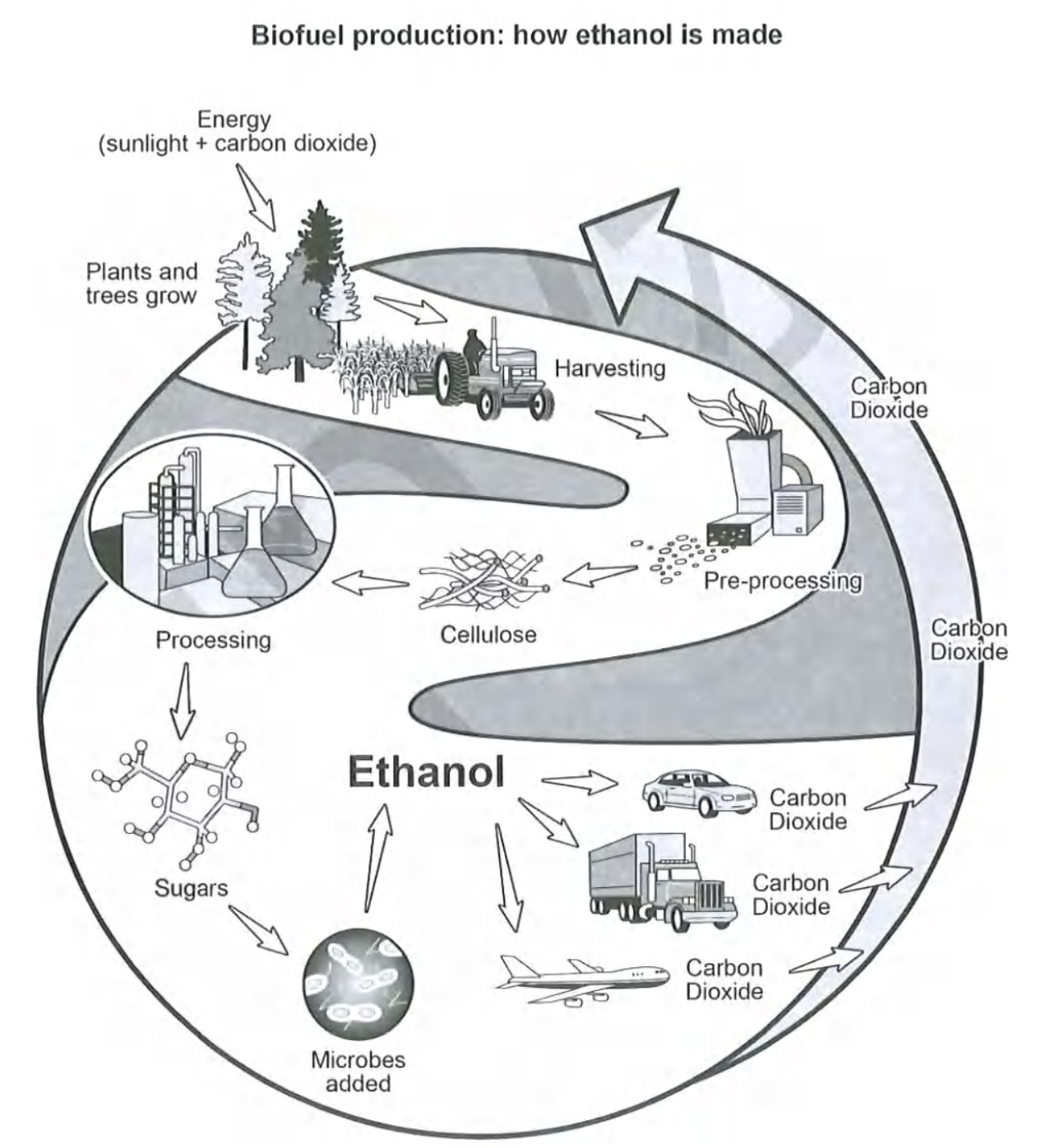
The diagram below shows how a biofuel called ethanol is produced.
Summarise the information by selecting and reporting the main features, and make comparisons where relevant.
Write at least 150 words.
Biofuel Production: How Ethanol is Made
Full candidate response
The given diagram illustrates the various stages in the process of producing ethanol, a kind of biofuel.
Overall, there are about 9 main phrases in the ethanol production, starting with growing plants and tress, and finishing with supplying ethanol for transportation and gas mission.
At the first stage in the process of making ethanol, a large number of trees and plants are grown. Thanks to the source of energy from sunlight and carbon dioxide from humman and transportattin, plants and trees grow up and are haverested when they are mature enough. After being collected by machine, they are put into another machine where slice them into small pieces to form cellulose. This step is call pre-processing.
In the following stage, cellulose are taken to a factory where “processing” stage occurs. Subsequently, Sugars are extracted from original cellulose before microbes are added to make ethanol. It is then used as a tupe of fuel for a lot of means of transportation such as cars, trucks, airplanes. Finally, a huge amount of carbon dioxide which is released into the air become energy for process of “photosynthesis” of plants and trees.
Full official examiner comment
This is a strong response. The first short paragraph is an introduction, then the second paragraph contains an overview of the process [starting with growing plants] and [finishing with supplying ethanol]. This is sufficient as an overview, but the candidate should also summarise the main stages. The rest of the response presents and highlights the process. Ideas are logically organised and the response follows the order given in the diagram. There is good use of linking words to describe a process [At the first stage | After being | Subsequently] and other linking devices, including reference and substitution [they | then used). The candidate uses vocabulary well with some flexibility [extracted | photosynthesis], but there are a handful of errors [phrases / phases | tress / trees || humman / human | transportattin / transportation | tupe / type]. These errors do not get in the way of the meaning. Grammatical range is quite broad and there is a variety of complex structures and sentences with multiple clauses. There are a few errors [where slice them / which slices them]. To achieve a higher score, an overview which summarises the main stages should be presented, for example: This cycle for biofuel production involves three main stages: harvesting and preparing plant material for processing, producing ethanol by chemical processing, then using the fuel for transportation, before the cycle begins again.
08
Cambridge IELTS 19 · Academic Test 3 · Task 2
Academic · Task 2
Band7.0
Words
336
Type
Task 2 essay
Full task question
It is important for everyone, including young people, to save money for their future.
To what extent do you agree or disagree with this statement?
Give reasons for your answer and include any relevant examples from your own knowledge or experience.
Write at least 250 words.
Full candidate response
Saving money for the future is always a very good idea. First of all money is something that is needed in almost all areas in life. Whether you are young or old you need money to buy everyday things like food, clothing, etc. living etc.
young people are often full of enthusiasm about their future. They are looking forward to their first job, to meeting new people or to getting to know as much of the world as they can. Many tend to live in the present rather than in the future so that they don’t always plan ahead.
When you people get older and settle down they realize that buying a house, starting a family or caring for your health takes up a good considerable amount of money and everybody who began saving money in younger years is glad to have done so. However, saving money is not always possible. Sometimes unforeseen expenses cannot be avoided, life situations are suddenly changing or there is never even enough money available even for the most necessary things. So how could you save money for the future in this case? In general, you have to ask yourself what your priorities in life are. What are the things you cherish most? Is it more important for you to plan ahead or do you prefer to just enjoy the moment that you live in?
Everybody has to make own choices and to consider what is really essential for him or herself.
In any age taking a moment to f reflect on your life and looking back at the things you have already done is always a good thing to do.
If you know yourself well and about all the things that really make you happy you will be able to make the right decisions in financial issues as well as other areas in life.
In what way money plays an important role will be easy to be found out then. Perhaps you need less than you first thought years ago.
Full official examiner comment
This is a strong response to the task. In the first paragraph, the candidate makes their view clear, agreeing with the statement that saving money for the future is a good idea. In the next two paragraphs, they present ideas on how saving money is actually quite challenging: young people can [tend to live in the present), so [don’t always plan ahead, the cost of housing, starting families and health care can be high, and [unforeseen expenses cannot be avoided). The rest of the response is about how people can decide how much to spend and how much to save. The last line [Perhaps you need less than you first thought years ago] suggests that saving is not the answer for everyone. The ending gives advice to the reader, rather than summarising the main ideas. Ideas are easy to follow and logically organised. Linking expressions are well integrated [Whether | Sometimes | Perhaps] and generally accurate, and cohesive devices are used well [Many tend to | everybody who] with some errors [own choices / their own choices]. Paragraphing at the start is appropriate, but the last four sentences are set out separately and inappropriately, which affects the score. There is some higher-level vocabulary, with effective collocation [full of enthusiasm | tend to live in the present | settle down | unforeseen expenses]. The candidate uses a variety of structures, including comparative forms [rather than | do you prefer], conditionals [/f] and a range of multi-clause sentences. Errors remain, with some missing punctuation and incorrect tenses [be found out / find out] and prepositions [In any age / At any age], but this does not affect the reader’s understanding. To achieve a higher score, the candidate should ensure that the conclusion summarises the main ideas, and use effective paragraphing, especially in the second half of the response.
09
Cambridge IELTS 19 · Academic Test 4 · Task 1
Academic · Task 1
Band5.0
Words
163
Type
Academic Task 1
Full task question
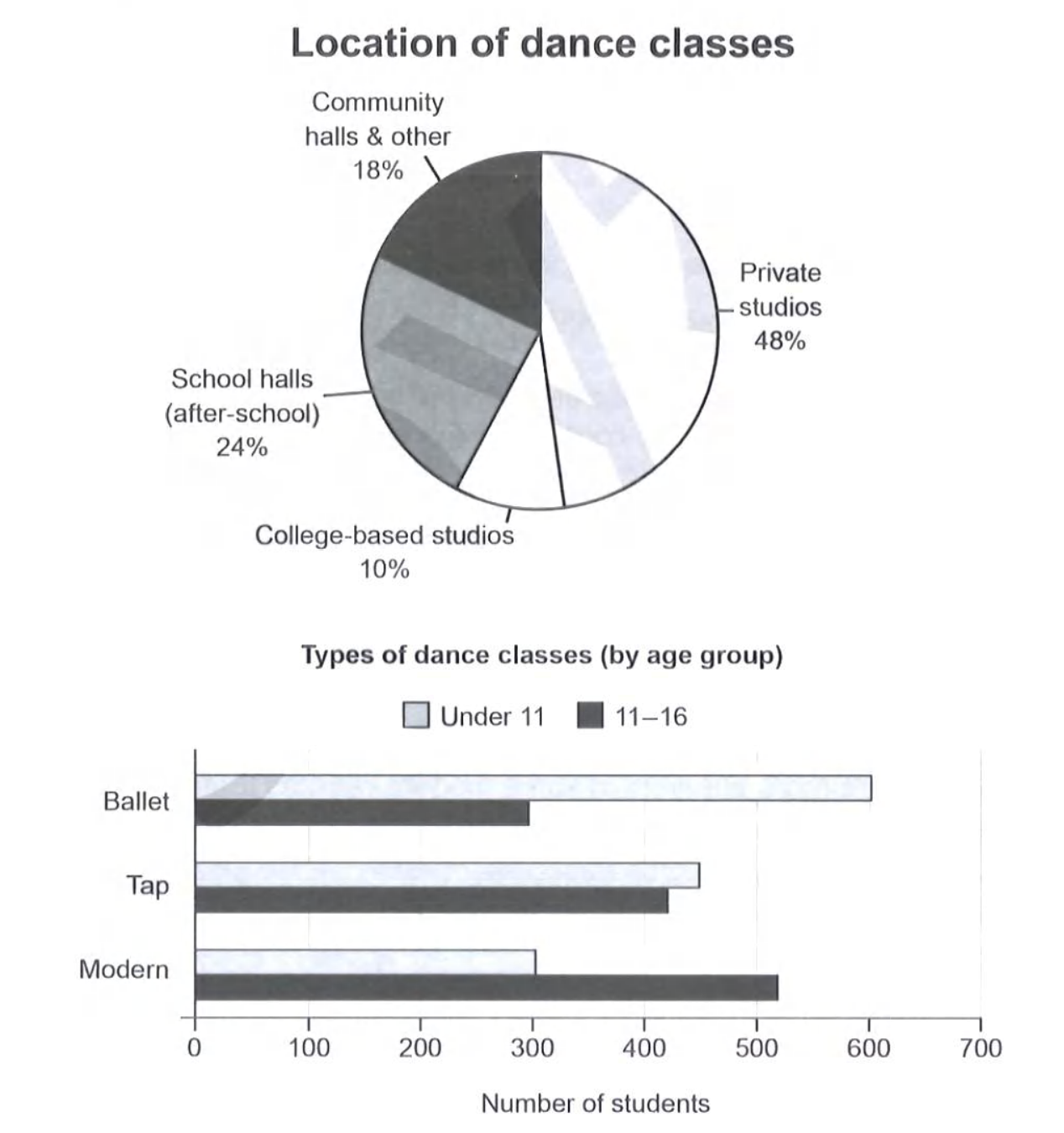
The charts below give information on the location and types of dance classes young people in a town in Australia are currently attending.
Summarise the information by selecting and reporting the main features, and make comparisons where relevant.
Write at least 150 words.
Location of Dance Classes
Full candidate response
The table and chart provide information about the location and different types of dance class undertaken by young people in Australia.
The chart says In Private Studios 48% young people are taking dance classes.
And in community halls and other 18% folks are taking dance classes And other location. After school classes 24% people are taking classes and other last one location college based studios these are 10% percent people Taking classes. The table reveal in Ballet type dance 600 students under age of 11 learning. And 300 age of 11-16 are learning. And 420 students age of 11-16 learning and last type of Dance Modern these are 515 students are learning who are under age of 11 and 300 other students who are age of 11-16.
To conclusion in Private Studio the numbers of people much higher than other locations. And type of ballet dance classes number of student Much higher in under age of 11 than other type of dance classes.
Full official examiner comment
This candidate has worked hard to report all data contained in the graphs. The key areas are covered, but the overall effect is rather mechanical, as each point is presented in a linear sequence. The ideas are set out in the correct order, following the order of the graphs in the question, but linking between and within the sentences is not strong. The format is quite repetitive [taking classes | learning] because of the lack of linking devices. Similarly, vocabulary is limited and a wider range would be needed for a higher score. Grammatical range is also minimal. There is a noticeable level of error, but the reader is still able to understand the message. To improve the score, this candidate should use a wider range of linking devices and take a less mechanical approach. A stronger and wider range of vocabulary and grammar would also be beneficial.
10
Cambridge IELTS 19 · Academic Test 4 · Task 2
Academic · Task 2
Band6.0
Words
288
Type
Task 2 essay
Full task question
In many countries nowadays, consumers can go to a supermarket and buy food produced all over the world.
Do you think this is a positive or negative development?
Give reasons for your answer and include any relevant examples from your own knowledge or experience.
Write at least 250 words.
Full candidate response
Today there are a lot of different shops where we can buy all kind of stuff produced all over the world. Is it right to buy food produced in other countries? Is this idea useful for people nowadays?
I suppose this to be a good idea. When supermarkets and even small shops provide people food from abroad then there are much more possibilities for us to choose something. When shops have only food and things produced in our country, it is really hard to make a good choise. Sometimes people want to try something new and interesting maybe even something extraordinary which they never buy before. In this cases food which is produced in other countries will help them to be satisfied with their demands. When supermarkets have a good suply of different food produced anywhere than people can find delicious things depending on their tastes. For example, people who like French products can buy some kinds of french cheese or wine not only in France.
Food from other countries is also very good when you want to buy some fresh vegetables and fruits in winter. It is really useful thing because some people are vegetarians and they need vegetables and fruits during the whole year.
The only disadvantage of food which is produced in other countries is the way how it has been delivered. in some cases products can be not so fresh especialy in summer, when it is very hot outside.
To sum it up, I can surely say that buying products from other countries is a good thing to become more closer to other culturies. You can certainly cook something unusial at home and it will taste like in very good expensive restaurant somewhere abroad.
Full official examiner comment
This is a good response to the task. The candidate clearly agrees with the idea that people should be able to buy international food in supermarkets. The main reason given is that people want to try something [new and interesting] and different. Examples are given of French products and seasonal produce for vegetarians. One disadvantage is given, related to the impact of hot weather on transportation. The conclusion includes bringing cultures together through food but does not summarise the points made in the full answer. A more relevant conclusion would help the candidate achieve a higher score, as well as further extending the ideas. Generally, the candidate organises the ideas well, and we can follow them clearly. Some good linking devices are used [where | maybe even | which | who], but some errors remain [this cases / these cases | than / then]. The response is set out across five paragraphs, but three of them have only two sentences. These are short paragraphs and could be extended to illustrate the central topic in more detail. Again, vocabulary is generally appropriate for the question, with some strong examples [extraordinary | depending on their tastes], but there is a lack of precision [stuff] and frequent minor spelling errors [choise | suply | especialy | culturies | unusial. However, we can still understand what is meant. There are attempts at a wider range of structures and a number of multi-clause sentences. However, the level of error [which they never buy before / which they have never bought before | the way how it has been delivered / the way it has been delivered] detracts from the score. Overall, a more comprehensive conclusion, longer paragraphs, a wider range of vocabulary and fewer grammatical slips would improve the response and achieve a higher score.
11
Cambridge IELTS 19 · General Training Test 1 · Task 1
General Training · Task 1
Band6.0
Words
177
Type
General Training Task 1
Full task question
You would like to reduce your working hours in order to study part time.
Write a letter to your boss. In your letter
explain why you want to reduce your working hours
say which hours you would like to work
describe how your part-time studies would benefit your employer
Write at least 150 words.
You do NOT need to write any addresses.
Begin your letter as follows:
Dear…………..,
Full candidate response
Dear Mr. Brent,
I hope this letter finds you well.
I am writing this letter to request my working hours in Lancom Technology to be reduced to 30 hours from 40 hours in a weekly basic.
I am requesting hours change due to study part-time. I have enrolled myself in Diploma of Logistics and Freight Forwarding. The part-time course is to be completed in 2 years time.
I would like to work from Monday to Friday from 7am to 1pm, so I could attend my classes on the afternoon session.
I hope this arrangement would allow me to gain more skills and knowledges, which I am confidently to contribute to our logistic department. Besides, the society exposure from lecturers and fellow schoolmates could contribute to our logistic network.
I am appreciate if you could look into this request and approve it. I am delighted to have face-to-face meeting with you to discuss any alternative.
Please do not hesitate to contact if you have any question. I am looking forward to hearing from you.
Thank you.
Yours sincerely.
Full official examiner comment
This letter is a good response to the task, the tone is suitable for writing to a manager and all aspects of the bullet points are presented. Benefits to the employer include [more skills and knowledges] that can be shared across the team, and an increased [logistic network]. The message can be followed as there is a clear progression, although due to the very short paragraphs, this does appear more like a list of information rather than a letter. Vocabulary has some good elements [enrolled | contribute to | discuss any alternative], but there is some lack of precision in word choice [weekly basic / weekly schedule | confidently to contribute / confident will contribute]. Grammatical structures are varied but limited overall. Strengths include [reduced to … from | is to be completed | so 1 could attend], but there are some errors, including missing articles (Diploma / a Diploma] and third person ‘s’ [logistic network / logistics network | any question / any questions], and use of modal forms [/ am appreciate / I would appreciate | I am delighted / I would be delighted]. To improve the rating, the ideas should be better organised into paragraphs within the letter. Instead of starting each sentence with [1, the candidate could introduce more variety with linking and grammatical structures.
12
Cambridge IELTS 19 · General Training Test 1 · Task 2
General Training · Task 2
Band6.0
Words
308
Type
Task 2 essay
Full task question
More and more people nowadays visit well-known places to take photographs of themselves, without looking at the place.
Why do you think this is happening?
Is it a positive or a negative trend?
Give reasons for your answer and include any relevant examples from your own knowledge or experience.
Write at least 250 words.
Full candidate response
Photography is actually be come trend. Now a day due to impact of Social Media People are not looking at the place they visit but rather concentrate on taking photographs of the place thinking that they will post them on facebook or instagram. They get a different kind of pleasure when they get more likes on their posts in the Social Media.
These are many reasons behind??? the fact that people have access to camera and internet and social media at their fingertips they have forgotten the value of the nature of the place they are visiting.
There are negative and positive impact over this situation. Firstly when we look at good things it is good that the Technology has given an advanced accebility to the high speed internet in our pockets and high defination cameras at a cheapest price.
This helps us to capture all that we need immediately. Secondly, there is no skill or learning of a certification required for that, even a kid is able to capture beautiful pictures using Mobile Phones.
Thirdly, it is giving opportunity as not to miss any thing that we capture to share at affortable price.
Though there are positive aspects for this practices, as bad also follows good, there are negative points that we need to think about as well.
One among these is privacy, when we post some of the photographs in social media, Every one will get to know as what is happening our life. The privacy is effected.
Secondly it is giving an opportunity for fradster’s to collect information like our address, Date of birth Age and so forth that they can get access to the Banking information and Scam and Rob the Money.
To conclude the positive things only give satification but the negative once are the real threats to personal information and individuals life.
Full official examiner comment
This response covers each main area of the task: brief reasons are given on why people are taking photographs of themselves without looking at the place they are visiting (the impact of social media and the pleasure people get from the likes’ on pictures they post) and much more detail is provided on the ‘positive or negative’ aspects of the trend. There is a clear progression overall and some good cohesive features [Firstly | Secondly | like | but]. However, there is repetition and error [These / There | good | privacy) and paragraphing is not very helpful. There is some higher-level vocabulary [impact of | concentrate on | different kind of pleasure | get access to] but also, some error in spelling [accebility | high defination | affortable | fradster’s | satification] and inaccuracy [Rob / steal | once / one] which impacts the rating here. Grammatical structures are mixed, with some good use (they have forgotten the value | need to | can], but generally, the level of error is quite high. A greater degree of accuracy in these structures would increase the score. Overall, to achieve a higher score, the candidate should add more on ‘Why do you think this is happening?’ and should provide a more comprehensive conclusion. It is also important to use paragraphing more effectively, to group ideas together.
13
Cambridge IELTS 19 · General Training Test 2 · Task 1
General Training · Task 1
Band5.0
Words
160
Type
General Training Task 1
Full task question
You are a member of an International Students’ club. The club is organising an event to celebrate popular food from around the world.
Write a letter to the event organiser, Luis. In your letter
offer to make a popular dish from your country
describe what this dish is
explain why it should be included in the event
Write at least 150 words.
You do NOT need to write any addresses.
Begin your letter as follows:
Dear Luis,
Full candidate response
Dear Luis,
I am writing to inform you that if it is possible can you please tell the couzine to prepare some special traditional food from my country. Which is called baby corn grill for me.
This very healthy and sweet as you probably know. We are going to do a physical exercise in the club, I need to have it, because it has a huge benefit for me to against the other team. I had an experience in my country everyone must have this dish and they have done a good job, because of the digestive of the food. However, you must not eat a lot because it contains variaty of proteins.
Just normal grill without any seasoning and addictives.
You should remember to let them know about that if not I will not do my best in this event.
Hopefully it’s ready before we start.
I look forward to hearing from you as soon as possible.
Kind regards,
Full official examiner comment
This response is an attempt to address the question, but the candidate has misunderstood the requirements. The bullet points ask them to offer to make this popular dish for the club event, but this response asks the manager to arrange for the dish to be prepared. This also affects the third bullet point, where instead of explaining why the dish should be included in the International Students’ club event to celebrate food, the candidate explains why their sporting team would benefit. The score for Task Achievement is affected by this inaccurate content. Apart from the inaccurate details, there is a sense of coherence within the letter. There are linking devices [because | However | Hopefully] with some use of referencing [it | me | other team | this], but there are errors [This very healthy / It is very healthy). Vocabulary is good enough for the task. There is some accurate use [special traditional food | seasoning] but with frequent lapses in word choice [couzine | digestive of the food and spelling [variaty / variety | addictives / additives]. Similarly, grammatical structures are limited. There are some accurate structures, including if clauses, modals, and a range of tenses [if it is possible | need to have | have done | must not | should remember]. However, errors do occur frequently, and punctuation is faulty and missing altogether in some places [about that if not I will not]. To achieve a higher score, the letter needs to fully address the task, and demonstrate a greater level of accuracy with vocabulary and grammatical structures.
14
Cambridge IELTS 19 · General Training Test 2 · Task 2
General Training · Task 2
Band6.5
Words
274
Type
Task 2 essay
Full task question
It is sometimes possible to pay somebody to do things you don’t want to do, or don’t have time to do, for example, household chores or looking after children.
Is this a good way of providing work for others?
Should people do these things themselves?
Give reasons for your answer and include any relevant examples from your own knowledge or experience.
Write at least 250 words.
Full candidate response
Nowadays it is becoming more difficult to find the necessary time to do the home work. Even tasks as simple as cleaning the house and cooking the dinner or as important as childcare, are being delegated to third parties such as nannies or private companies.
Some people could say it is helpful to have someone who support ourselves at home. Not only because we usually do not have time to do it, but because we can promote jobs for other people.
However I strongly believe that we should spend less hours at the office and much more hours at home. Doing that we should be able to carry on all the duties we use to have in the houses.
I think there certain activities we should not pass to others. For instance, taking care of our children. This is something that we, as parents, should do for ourselves. No one else could provide the kids all the love, understanding and friendship that a mother or father give to them.
I remember that when I was a child, my mother quit her job and she dedicated all her time and effort to look after my brothers and I. Now, I realized that it was an invaluable time impossible to have with somebody else different from our own mother.
Summarizing, even though some people found useful to have others helping us in our duties at home, I think we should do it for ourselves because it provides valuable time at home. So that we should work less and spend more time sharing with our families. No matter if it is household chores or looking after children.
Full official examiner comment
This is a strong response to the question and the candidate’s position is clear from the beginning. The candidate argues that people will find most satisfaction doing the work themselves at home. There is some consideration of the other side, and the conclusion is clear and relevant. Ideas are sequenced logically and cohesion is managed well with some good cohesive devices [Doing that | Summarizing] but some overuse. There are a few slips [who support ourselves / to support us]. Each paragraph presents a clear central topic. Vocabulary is natural and accurate [certain activities | quit | invaluable time]. Sentence structure shows a variety of complex structures including multi-clause sentences, but a higher degree of accuracy would improve the response.
15
Cambridge IELTS 19 · General Training Test 3 · Task 1
General Training · Task 1
Band5.5
Words
164
Type
General Training Task 1
Full task question
Five months ago, you started renting an apartment on a six-month agreement. You now wish to stay in the apartment for longer than the six months you originally agreed with the owner.
Write a letter to the owner of your apartment. In your letter
say how long you now want to rent the apartment for
explain why your plans have changed
tell the owner about a problem in the apartment
Write at least 150 words.
You do NOT need to write any addresses.
Begin your letter as follows:
Dear……,
Full candidate response
Dear Mr Banks
As you know, my 6 month lease is about to expierd next month and I’m writing to you with a request to extand it for 6 more month, as my sircumstents had changed.
When I just arrived to Adelaide I wasnt sure that i’ll be able to stay more then 6 month. I got a 6 month contract with my work place and that was suppuse to be it. Last week my boss who is apperoutly have a good imprassion of me, ask me to stay and maunage another project here in the city. So, if it’s possible, i’ll love to extand ower agreement. I really love the apartment, the view is lovely and the nightbrohood is friendly, although I do have one problem? The back door is broken and i’ll aprishiate you help in that metter, espisialy if I’m going to stay throw the winter, which I understan can be quit cold and windy around here.
Thank you very much
Full official examiner comment
This letter covers each area of the task and provides a nice level of detail. The request is to extend the lease for a further six months, plans have changed due to a work opportunity and a problem with the back door is highlighted. The tone is suitable for writing to the owner of the apartment. Ideas are organised coherently and progression is clear. There are a range of cohesive devices [So | although] and helpful use of referencing [it | who | which]. Unfortunately, there is a high level of error in spelling. This does detract from the score, which is a shame as this writer is clearly trying hard to include a good range of vocabulary. Unfortunately, the errors are noticeable because there are so many of them [expierd / expired | apperoutly / apparently | extand ower / extend our | nightbrohood / neighbourhood | espisialy / especially]. There is a mix of simple and complex grammatical structures, with some good examples [is about to | if it’s possible | if I’m going to stay]. However, again, the level of error is quite high and is noticeable. There are errors in plural forms [6 more month / 6 more months] in use of past tenses [ask / asked] and future forms [”I love to / I’d love to]. The content of this letter covers each area of the task, but to achieve a higher score, the candidate should demonstrate a greater level of accuracy with vocabulary and grammatical structures.
16
Cambridge IELTS 19 · General Training Test 3 · Task 2
General Training · Task 2
Band5.5
Words
300
Type
Task 2 essay
Full task question
Some consumers are increasingly choosing to buy goods that are produced in their local area, rather than imported goods.
What are the reasons for this?
Is this a positive or a negative trend?
Give reasons for your answer and include any relevant examples from your own knowledge or experience.
Write at least 250 words.
Full candidate response
Yes, this is a positive trend, but when you know about that manufacturer company, about their service, quality, quantity etc. If you buy goods from you known brand then it is good for you because you get good product.
Goods are produced in local areas are cheaper than imported gods. There is a big price difference in local and imported goods. All people are not reached so those who are not afford imported goods they automatically turn to local goods.
If you buying any goods from our local brand then the money remain in our area & this is very helpful to make our economy strong. We have to buy only those product that made or produced in our area because it gives money, job to our area.
There are verious frouad companies selling duplicate of first copy imported goods. So this is also the one reason or kind of fear for not buying imported goods. There are verious charges applied when we buy imported goods and for local goods there are no such charges or taxes applied.
Hear I would like to share my experience. I buy a jeans of Lewis brand of rs 4000 after some days the colour of pant become lighter day by day, I feel very bad because I invest 4000 rs on jeans only because Lewis is an imported brand, then I thought if I buy jeans from local area then I get 4 jeans in 4000 & I realised I did mistake & from that day I choose to buy goods that are produced in my local area rather than imported goods.
I suggest you that, I you want to be a part of our developing country then buy goods from our local brands this helps to keep our money in our country.
Full official examiner comment
This response addresses both parts of the question: the reasons for consumers buying local goods, and whether this is positive or negative. In the first line, we see the writer thinks it is a positive trend. Then reasons are given for buying local goods rather than imported goods: if the product is local, it will be a good product; locally produced goods will be cheaper; the money will remain in the local area, helping the local economy with jobs and money; and buying local will avoid buying fake goods. A personal example is given to illustrate the positive trend. The conclusion is really ‘giving advice’ to consumers to buy local brands to develop their local economy. There is progression through the response, but linking expressions are largely missing or incorrect [Hear / Here | / suggest you that / | suggest that]. However, cohesive devices are sometimes used well [those who | our | those product that) but can be faulty. Vocabulary has an adequate range, with some good collocation, [known brand | price difference | no such charges or taxes applied] despite some errors in spelling [verious frouad / various fraud]. There are some examples of complex sentence forms, for example, in the fourth paragraph, but there are quite frequent grammatical errors. To achieve a higher score, the candidate should present the ideas around the ‘positive and negative trend’ more clearly. Their conclusion should summarise the main arguments, rather than ‘give advice’ to local consumers. They should also demonstrate a greater level of accuracy with vocabulary and grammatical structures.
17
Cambridge IELTS 19 · General Training Test 4 · Task 1
General Training · Task 1
Band6.0
Words
191
Type
General Training Task 1
Full task question
You started in your present job two years ago. And you now feel it is important for your career development to move to a different department in the same company.
Write a letter to your manager. In your letter
say what you have learned in your present job
suggest how the company would benefit from moving you to a different department
explain why you do not wish to leave the company
Write at least 150 words.
You do NOT need to write any addresses.
Begin your letter as follows:
Dear……,
Full candidate response
Dear Sir.
I am writing to ask for a permition about changing my position. As you know, I have already work in sales department for two years which let me learn a lot of skills of sales and helped me becoming the best sales man the season. However, I would like to require moving to Design department and I would state my reason in the following paragraphs.
First of all, I would like to thank you for giving me many chances to equip my sales skills, such as negociating with clients, promoting product and most importantly, getting over fears of meeting strangers.
However, inspite of sales skills, I eager to learn more skills in the company. Especially, I am always interest in design our company’s product. Moreover, I have got some certificates from self learning and understand some design skills when I was asistanted my colleage from design department.
Besides, I really love this company. The environment and working feeling are perfect here. So, those are why I am keen to stay in this company.
Thanks you for your reading and I look forward to hearing from you soon.
Yours faithfully,
Full official examiner comment
This letter is a good response to the task and the letter format is appropriate and helpful. However, the second bullet point, which is to suggest how the company would benefit, is not well covered. In the third paragraph, there is mention of an increased understanding of design skills from another department, but it is not entirely clear how this benefits the company. More could be added on this point to improve the response. Nevertheless, ideas are arranged coherently and there is good progression. Some useful linking devices are used [However | First of all | Moreover | Besides], although they all come at the beginning of the sentence. We also have reference and substitution (in the following paragraphs | are perfect here], but there are errors [those / that is]. There is some good vocabulary, but there are also errors which detract from the score [permition / permission | asistanted / assisting] but do not have too much impact. Grammatical structures contain some stronger examples [would like to thank you for | why I am keen to stay], but overall, the level of error is quite high. In order to score more highly, the candidate should clearly highlight all three bullet points and extend responses. There should also be greater accuracy in spelling and fewer errors in the grammatical structures.
18
Cambridge IELTS 19 · General Training Test 4 · Task 2
General Training · Task 2
Band6.5
Words
316
Type
Task 2 essay
Full task question
Nowadays famous people are photographed by professional photographers everywhere they go. Some people say this is a good thing because the public are interested in their lives. Other people think that photographers are wrong to follow famous people.
Discuss both these views and give your own opinion.
Give reasons for your answer and include any relevant examples from your own knowledge or experience.
Write at least 250 words.
Full candidate response
It is always a debatable topic whether photographers should follow famous people to get information about their lives. One class of people says it is good and photographers should do it while another class comments that it is not good to interferes someone’s life. Before giving my opinion, I would like to discuss both the view points in detail as given in coming paragraphs.
There is one group of people who believe that photographers should always follow well known celebrities and try to get photos and information about their life. As the fans of that particular celebrity are very interested in such news and information. By getting this type of details, fans would love to follow that person’s habits, style, clothing, etc. For example, one of my friend Ketul is a big fan of famous filmstar Salman Khan. He used to follow him and wearning same clothes, Keeps similar hairstyle as Salman Khan is having. One more reason is that the photographers taking pictures of such famous personalities and spreading it via different social media makes that person more famous. In many cases, that celebrities like this thing.
On the other hand, another group of people believe that photographers should not do this. Following someone and taking pictures of his/her personal life is wrong. Celebrities are also a human being.
They also want some space apart from their career. There are some cases where these personalities were upset and angry on photographers for doing this. For example, in December 2011, Priyanka Chopra (a famous actress) field a case against a photographer for the same.
In conclusion, I would like to say that the photographers should do this but with the permission of that celebrities. Taking pictures of someone without informing is always wrong. Getting pictures of famous personality is people’s demand and famous people should always satisfy his/her fans by allowing photographers to take their pictures.
Full official examiner comment
This is a good response. The candidate presents ideas on both sides (whether it is right or wrong for photographers to follow famous people) and gives a clear opinion at the end. There is a demand for photographs of famous people; some people think it is acceptable for photographers to go ahead, as the fans demand it (an example is given of a famous film star) and some celebrities like it, as it makes them more famous; and others think it is wrong, as celebrities are also human beings who deserve some [space] (an example is given of another celebrity). The conclusion draws both sides together. The response is logically organised. There are a range of linking devices [Before | One more reason | On the other hand] and the candidate uses cohesive devices within sentences effectively, such as referencing [people who | that person | this type]. Vocabulary is good with some higher-level collocation [particular celebrity | taking pictures]. There are a few errors in spelling [wearning / wearing] and word choice, but they do not impede communication. There are a variety of complex structures and frequent sentences with multiple clauses. To achieve a higher score, the candidate should demonstrate a greater level of accuracy with vocabulary and grammatical structures.
19
Cambridge IELTS 20 · Academic Test 1 · Task 1
Academic · Task 1
Band5.5
Words
181
Type
Academic Task 1
Full task question
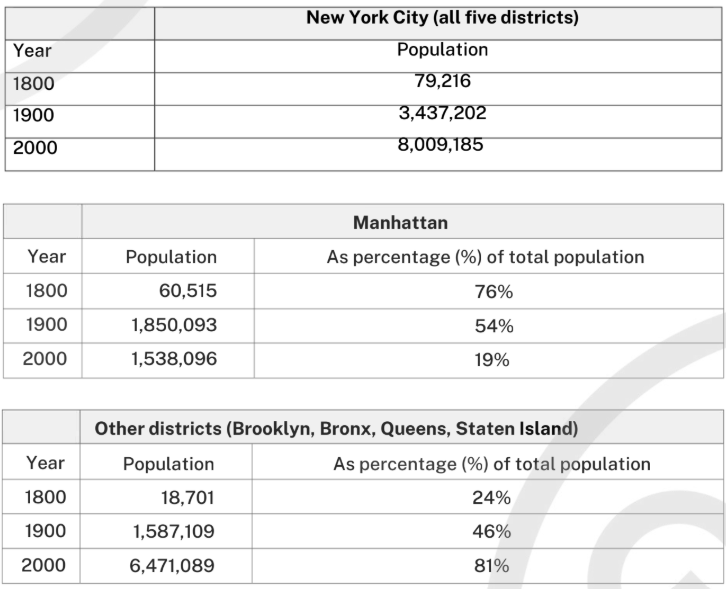
The first table below shows changes in the total population of New York City from 1800 to 2000. The second and third tables show changes in the population of the five districts of the city (Manhattan, Brooklyn, Bronx, Queens, Staten Island) over the same period.
Summarise the information by selecting and reporting the main features, and make comparisons where relevant.
Write at least 150 words.
Full candidate response
The first table shows changes in total population of New York city from 1800 to 2000. In 1800, New York's population was 79.216 then in 100 years the population sharply increased as over 4 times in 1800. Next 100 years, it still became more as it increased over twice as much as in 1800. Other two tables show changes of population in five different areas in New York. In 1800 Manhattan has 60.515 On the other hand other four areas, Brookly, Bronx, Queens and Staten Island had only 18.701. Manhattan has almost three times more than group of other four cities also. It had 76% of population in New York. It tells us Manhattan was the busiest city in New York. In 1900, Manhattan's populat increased sharply however, other broughs had bigger change. Population rate rise dramatically as 1587.109.
In 2000 other broughs had 6471.089 and 81% of population of New York. On the other hand Manhattan's population has dicreased and it became only 19% of New York population. Last 200 years people chose to live differant cities in New York.
Full official examiner comment
This response is a good attempt at the task; however, selected information is limited and there are some inaccuracies. For example, data for Manhattan are minimal, and there is some inaccuracy, [in 1900 other broughs had bigger change]. There is also a small error in the final sentence, [chose to live differant cities], this should be 'different districts' because the city is New York City. The score is also impacted by the lack of an overview. The last sentence is an attempt at an overview, but is not sufficiently specific. The information is arranged coherently, with some good use of cohesive devices [then in | on the other hand | it | however] but there is repetition [on the other hand | in], and the range could be wider. Vocabulary is generally adequate, with some good examples [sharply increased | dramatically | chose to live], but there are some noticeable spelling errors [populat | dicreased | differant]. Similarly, grammatical range is limited in this response. Some good use of comparative structures [increased over twice as much as | has almost three times more than | was the busiest]; however, there are errors, including choice of tenses and missing articles.
20
Cambridge IELTS 20 · Academic Test 1 · Task 2
Academic · Task 2
Band6.5
Words
349
Type
Task 2 essay
Full task question
Access to clean water is a basic human right. Therefore, every home should have a water supply that is provided free of charge.
Do you agree or disagree?
Give reasons for your answer and include any relevant examples from your own knowledge or experience.
Write at least 250 words.
Full candidate response
Access to pure clean water is for sure a necessary right for all human beings. It is one of the things needed to survive on this planet. Now, some people might argue that only and only water is required and the state of cleanliness of it should be a secondary thing to ensure, while other argue that there is no point in having water which, in some cases is not clean. can result to be fatal.
However all this debate comes down to one point whether or not this water shall be free of cost for humans. Let us look at it from a more fimiliar approach. All humans on earth have free will and a sight to life; what will happen if one day someone comes up to us and says that is is he or she who owns the air that we breathe in and just like that forces us to pay for over lives. This would not be acceptable to any human and they would be taking measures against.
Just like that our earth was created with all the water it had even before humans came into existence hence proving us that no person or no government is the sole protector of the earth's water resources.
Water was created for the dwellers of soil and creatures of the sea and all mankind to utilize. The creator of it did not ask us to pay for it by any means of money then who are we to charge for such a basic thing which we do not even own?
We all have seen countries going to war claiming the ownership of the water resources and if one of them does win all the effort goes down to nothing when in the end they tax their own countrymen for it.
It is clear that access to clean water is a basic human right. Therefore every home should have water supply is free. It is the responsibility of the authorities to look after the needs of the people as it them who declared clean water as a basic right.
Full official examiner comment
This is a good response that provides relevant ideas. The writer expresses their position, and agrees with the statement that access to clean water should be free, although there is some repetition and some lack of clarity within the main ideas expressed. There are supporting arguments that include: whether any kind of water, or only 'clean water' should be provided, whether people should be allowed to 'own' the air we breathe and force people to pay for it, whether any person should be the [sole protector] of the water supply and whether the aim is to [tax their own countrymen] for water. The conclusion states that governments have declared that clean water is a basic right, and so they should look after the needs of the people, and provide [every home] with a free water supply. Ideas are generally logically organised, but there is a lack of progression around the sections that refer to the ownership of water on planet earth, with repetition across three paragraphs (2, 3 and 4). However, generally, ideas are arranged in order and we can follow the progression through the response. Cohesive devices are used to some good effect, including referencing within sentences [while | us | who | their own countrymen]. However, paragraphing is not used effectively to sequence ideas, so more effective paragraphing could increase the score. There are some strong examples of vocabulary [comes down to one point | forces us to | look after the needs of] with some higher-level collocation. However, the level of error is quite high and detracts from the score for lexis. Grammatical range is also fairly wide, but again, the errors and missing punctuation mean that the response cannot score more highly. To achieve a higher score, the candidate should provide greater clarity when extending the main ideas, and use more effective paragraphing to organise ideas and improve progression.
21
Cambridge IELTS 20 · Academic Test 2 · Task 1
Academic · Task 1
Band6.0
Words
244
Type
Academic Task 1
Full task question
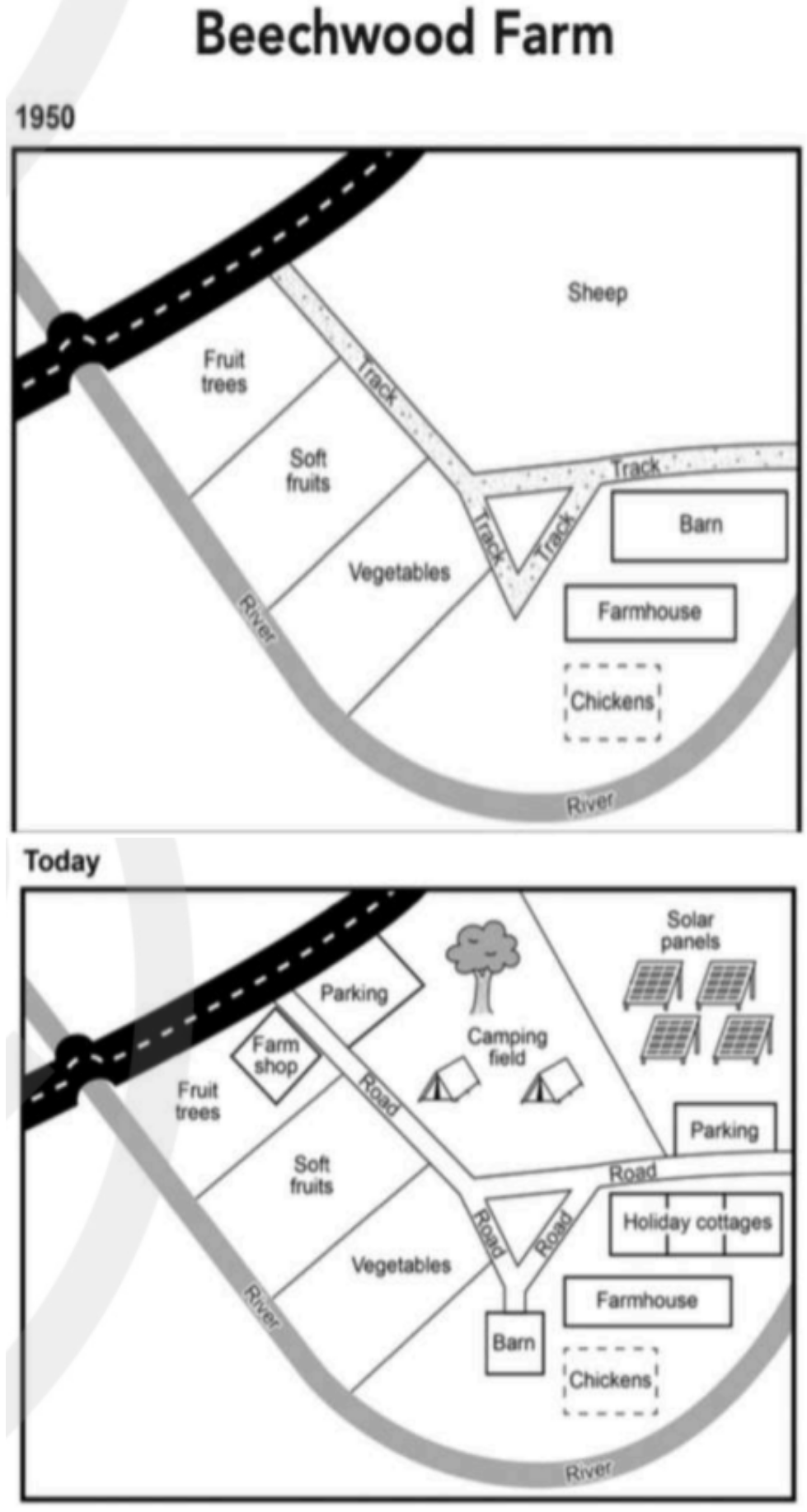
The plans below show the site of a farm in 1950 and the same site today.
Summarise the information by selecting and reporting the main features, and make comparisons where relevant.
Write at least 150 words.
Full candidate response
If we look at the pictures we will see how Beechwood Farm has changed along the time.
Years ago, in 1950, Beachwood Farm was a tipycal farm. A track crossed the farm, so farmers could reach the barn and the farmhouse passing by the fruit trees, and the place where the soft fruits and the vegetables were growing. At the opposite side of the truck, was the field where the sheeps were situated. That was close to the farmhouse, were chickens were also situated. All the farm was sourrounded, at the south, by a river.
Nowadeys, the farm has suffered changes. Modern life brought to the farm some needs to survive. The main change was the road that replaced the track. Now is easyer to arrive any place in the farm.
There is a parking zone near the road where the sheeps used to eat grass. We can also find a camping field and Solar panels in that zone. Another parking zone can be find where the solar panels are situated. Just in front of the first parking zone we can see a farm shop. The old barn was replaced for a holiday cottoges, and relocated close to the chickens, near the river.
Lot of things have changed since 1950, and Beechwood Farm is not an exception. Modern times had come, and everyone had to be adjusted to new ways of living. We still have Beechwood Farm, but a new sophisticated and modern one.
Full official examiner comment
This response addresses all of the changes illustrated in the farm plans. The writer describes how the farm looked in 1950, then moves on to the present-day plan. There is an overview in the last paragraph [Lot of things have changed since 1950, and Beechwood Farm ... a new sophisticated and modern one] but it does not mention the link to attracting visitors, so is not complete. Information is generally arranged coherently. The first two paragraphs cover the 1950s site, with the remainder focused on the farm today. There is evidence of linking expressions [At the opposite side | That | Nowadeys]; however, there is a lack of reference, resulting in repetition [farm | zone]. Vocabulary is generally good [parking zone | relocated | exception | adjusted | sophisticated] but errors remain [along the time / over time | tipycal | sourrounded | Nowadeys | easyer | cottoges]. Grammatical range is mixed. There are examples of complex sentence forms, including [If] clauses and modal forms [could reach | can also find] but there are also a range of errors which preclude a higher score. To improve the score, an overview that summarises the main changes should be added. It would also be beneficial to show greater accuracy in vocabulary and use of grammatical structures.
22
Cambridge IELTS 20 · Academic Test 2 · Task 2
Academic · Task 2
Band7.0
Words
306
Type
Task 2 essay
Full task question
In many countries, primary and secondary schools close for two months or more in the summer holidays.
What is the value of long school holidays?
What are the arguments in favour of shorter school holidays?
Give reasons for your answer and include any relevant examples from your own knowledge or experience.
Write at least 250 words.
Full candidate response
In today's world, education is a must to every child and individual across every country. The duration of summer holidays became a major thing in terms of priority in some countries like in middle eastern location. Where as cold countries which experience long winters have concentrated less on summer holidays giving only few weeks for summer vacations.
On the other side, a regular family would like to spend most of the time in summer holidays by travelling to their homeland, meeting their relatives and seek long durations for summer, so that children can spend valuable time with cousins and relatives making valuable memories. On the other hand, some parents who work 365 days would find it difficult to take care of children during summer holidays as they have to work and prefer shorter period of holidays.
This has become a major problem and is affecting children in a bad way. Childhood is to cherish some good valuable memories along with studies. Longer summer breaks allow the children to make time to visit family relatives and this early relationship helps to maintain a stronger bond for the rest of the life. Once they are out of school, they have to work and make a living for themselves where they won't find time for their loved ones.
Coming to shorter school holidays, they help the children from falling back in studies (or) having interest. With longer duration of holidays children take a lot of time to get back their concentration after the school starts. It has both positive and negative side to it. Shorter school holidays help the student to maintain concentration, performance but at the same time they won't form special bonds which are really important.
From my perspective, maintaining strong relationship bonds is more important than just education which requires a longer duration of summer holidays.
Full official examiner comment
This is an appropriate response, with a series of ideas for each part, presented effectively. It starts with a note that different countries have different patterns. The value of long holidays include families being able to travel and spend time with relatives, as once children leave school, they won't have the free time to develop these strong bonds. The arguments for shorter holidays mention families where parents work and cannot take so much leave, and that it helps children not to fall behind in their studies. The candidate concludes that stronger family bonds are more important, so longer holidays are best. There is some minor repetition in the ideas presented. Ideas are logically organised, and cohesive devices are varied. Reference is used [This | they | their] but some inaccuracy in linking devices [Where as | On the otherside | Coming to], and some repetition [relatives | valuable] limits the rating in this area. Vocabulary is a strength, with frequent high-level content and some skilful collocation [spend valuable time | affecting children | maintain a stronger bond]. Some errors remain [falling back / falling behind]. Grammatical structures are also varied and show some flexibility and some multi-clause sentences. However, most sentences are not error-free, as there are slips with prepositions [to every child / for every child | in holiday / on holiday] and plurals [shorter period of holidays | side / sides] and some missing punctuation. To achieve a higher score, the candidate could explore the 'value of long holidays' and 'arguments for shorter holidays' in more depth. A greater degree of accuracy in vocabulary and grammatical structures would also improve the score.
23
Cambridge IELTS 20 · Academic Test 3 · Task 1
Academic · Task 1
Band5.0
Words
144
Type
Academic Task 1
Full task question
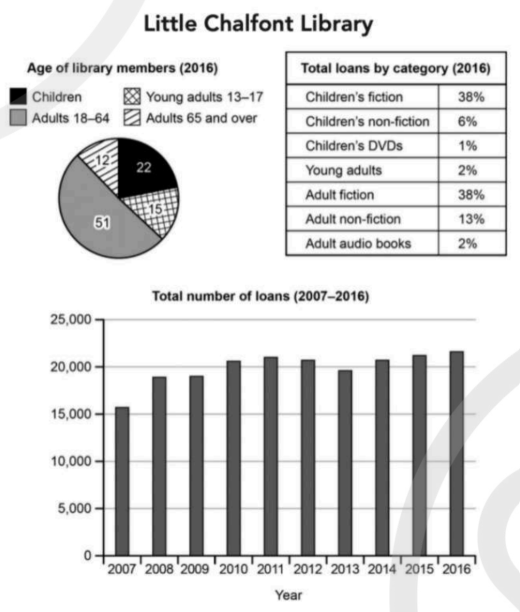
The charts below give information about a public library in a town called Little Chalfont.
Summarise the information by selecting and reporting the main features, and make comparisons where relevant.
Write at least 150 words.
Full candidate response
The illustration show information about a public library in a city which called Little Charfont. The member of library is mostly compose by Adults. It is around in half, the rawest is adults 65 and over.
Fiction is the most popular category either children or adults. Both of them are recorded by 38%. Wheras, nonfiction is less popular than fiction. It is 13% and 6% for children. The visualisation's categories, such as DVDs and audio books are lowest in the same binding which is total number of loans.
The bar is starting as the lowest in 2007. It is about 15,000. However, It has been slowly rised up until 2011. Unfortunately, It is likely to decrease as 2009 during 2012 to 2013. Nevertheless, It has been surprisingly increased by 2016. In 2016, It break new record In the chart. It could be about 21,000!
Full official examiner comment
This response does present data for each of the charts, and generally answers the question. There is limited detail though, for example, when describing the pie chart for the age of library members, we are told that the members are mostly adults, and those 65 and over are the [rawest]. There is no mention of children and young adults, and no reporting of the data in the pie chart itself. This means that only limited details are presented. Ideas are organised, and there is an underlying sense of meaning but some lack of progression. Sentences are not fluently linked to each other. Cohesive devices tend to be overused [which | Both | such as | However | Unfortunately | Nevertheless], and some are faulty [Wheras / Whereas]. There is some reference [It], but this is used repetitively, especially in the last paragraph. There is an attempt to use a range of vocabulary [less popular | visualisation's | break new record]; however, overall, the frequency of error, and the mistakes in word choice [rawest / lowest | binding / ?] limit the score for vocabulary. The range of grammatical structures is also limited. The response should be written using past tenses, as the data covers 2007 to 2016, but is mostly written in the present tense. Sentences are generally short, and the level of error is noticeable for the reader. This response could be improved by including an appropriate overview, and providing greater accuracy across vocabulary and grammatical structures.
24
Cambridge IELTS 20 · Academic Test 3 · Task 2
Academic · Task 2
Band7.5
Words
272
Type
Task 2 essay
Full task question
Some people have decided to reduce the number of times they fly every year or to stop flying altogether.
Do you think the environmental benefits of this development outweigh the disadvantages for individuals and businesses?
Give reasons for your answer and include any relevant examples from your own knowledge or experience.
Write at least 250 words.
Full candidate response
Many people nowadays have decided to stop flying or to limit the amount of times they use this form of transport. This will undoubtedly have great benefits for the environment, but it may mean that for individuals or businesses this can translate to higher expenses. I believe the disadvantages for individuals and businesses would be greater than the effects on the environment. This essay will discuss advantages and disadvantages of this.
Environmental benefits of reduced air travel would have a direct effect in the amount of pollution in the air, which would mean a greener planet. However, this would also mean a rise in the use of other types of transportation. For example, if the amount of cars, buses or trucks on the road increases this also means greenhouse gas emissions increase too.
On the other hand, for individuals or businesses this could mean higher travelling costs, as well as lengthy trips and possible delays in reaching their destinations. All of this can affect the companies resources and even possibly cause them to lose business deals, or not even commence them due to restricted trading times. Higher costs for companies can cause job cuts which can have devastating effects for families.
In conclusion, I believe the disadvantages on individuals and businesses caused by a reduction in air travel are far greater. The potential implications for companies of higher travel and shipping costs, could reflect losses that can eventuate in job cuts. The effects on the environment would not be enough to merit such a drastic culture change and possibly pollution levels could rise as a result of the increase on other contaminants.
Full official examiner comment
This is a strong, detailed and well-developed response. There are several appropriate ideas; the position is presented in the first paragraph and it is evidenced consistently. To improve this response, there could be more detail on the impact on 'individuals' as most of the examples refer to 'businesses'. The ideas are organised logically and the paragraphs support overall coherence. Cohesion is used well throughout, and the message can be followed easily. Vocabulary is fluently and flexibly used [translate to higher expenses | devastating effects | potential implications] with accurate spelling and only occasional errors in word choice [commence them / start them | eventuate in / result in]. Similarly, the range of grammatical structures is wide. There are frequent multi-clause sentences and the response is mostly error free.
25
Cambridge IELTS 20 · Academic Test 4 · Task 1
Academic · Task 1
Band6.0
Words
195
Type
Academic Task 1
Full task question
The diagram below shows how fabric is manufactured from bamboo.
Summarise the information by selecting and reporting the main features, and make comparisons where relevant.
Write at least 150 words.
Full candidate response
The given diagram describes the process of manufacturing bamboo fabrics. Overall, the process includes a few main stages, which are showen on the diagram and are numbered from 1 to 8.
The first stage, obviously, consists of planting and growing bamboo plants, usually happening in spring.
The second phase, We could say harvesting one, is happening in the middle part of the year in autumn. Bamboo stems are cutting off by the season workers, collecting and sendening to the special plants during this period.
In the plants, what are showed a the third and the forth stages. on the diagram, the bamboo stems are cutting into long strips, then produced strips are crushing to make liquid pulp.
During the next phase these pulp is filtering through the special types of sieves to separate long fibres from liquid.
Then the fibres, filtered by previous step, are being undergone through the softenning procedure. This procedure includes adding water and amine oxide.
The seventh stage is the sppinning the soften fibres to make a strong bamboo thread.
Produced yarns might be used to make fabric, which is the last - eighth phase, by weaveing them using special equipment.
Full official examiner comment
This is generally a good response, and it presents the key stages shown in the process. There is an overview, but it is rather generic and only tells us how many main stages there are [main stages ... are numbered from 1 to 8]. To improve the overview, instead of reporting the number of stages, there should be a summary of the main stages. Ideas are arranged logically. There are some nice linking expressions, appropriate for a 'process' [The first stage | then | During the next phase | which is] but there is some repetition [The first stage | The second phase | third and the forth stages | next phase | seventh stage | eighth phase]. Most of the sentences start on a new line - this means paragraphing is not present. Vocabulary is appropriate and spelling is generally well managed but there are errors. Grammatical structures are mixed but errors in verb forms are noticeable, particularly in passive structures [are cutting / are cut | are being undergone / undergo]. To achieve a higher score, the candidate should present an overview which summarises the main stages and paragraphing should be used to better organise the stages.
26
Cambridge IELTS 20 · Academic Test 4 · Task 2
Academic · Task 2
Band7.0
Words
282
Type
Task 2 essay
Full task question
Many aspects of the way people dress today are influenced by global fashion trends.
How has global fashion become such a strong influence on people's lives?
Do you think this is a positive or negative development?
Give reasons for your answer and include any relevant examples from your own knowledge or experience.
Write at least 250 words.
Full candidate response
The way many of us are dressed today is believed to be affected by the fashion industry. The reason why it is so importent for some people to choose their clothes according to the trends may be in our dependence on what is popular at the moment which is a double-edged sword. Of course, trying to keep up with modern fads consumes pretty much time and energy, but is it really that negative in terms of maintainig individuality? To my mind, it is not.
Not surprisingly, global fashion has influenced people's tastes in clothing a great deal. We all see those celebrities on TV and on the Internet boasting their brand new outfit making many men and women jealous. Would blond hair in concert with a white dress have been so popular back in the day if it had not been for the voloptious Marlyn Monroe? world-wide famous fashion designers keep surprising consumers with their wild imagination producing more and more types of style. For instance over-sized winter coats have drawn attention not only from the youth but from the middle-aged as well.
Fashions by many are believed to dictate people how to look. They impose new styles, and some people wear certain clothes just because another designer told them to do so.
Looking on the bright side, there's absolutely no harm in getting advice from the fashion industry on what to wear this season. Moderation is the key. Do not overdo it. If you put on a garment that is really comfortable and suitable for you, it does not really matter whether it is fashionable or not. Your individuality won't be hurt if you simply like something that is in trend.
Full official examiner comment
This is a strong response overall. The first part, on the influence of global fashion trends is clear and detailed: people are influenced because they see celebrities on TV and the internet, want to copy famous icons like Marilyn Monroe, continue to be surprised by designers' wild imagination and experience more and more styles. The response to the second part is less well covered. The 'negative' side of this question is not addressed very thoroughly, apart from saying it takes [time and energy] to keep up with modern fads. The 'positives' include that there is [no harm in getting advice] on what to wear. More focus on the second part would improve the response. Progression is logical. Linking expressions are appropriate [Of course | For instance | Looking on the bright side] with some good examples of reference [their | those | another] and paragraphing is helpful (although paragraphs 3 and 4 could be combined as they cover the same idea). Vocabulary use is strong with some precise meanings and effective collocation [keep up | modern fads | influenced people's tastes | impose new styles]. There are some small slips in spelling [importent | maintainig | voloptious] although the meaning is clear. Sentences are varied and contain complex structures. There are multi-clause sentences with a range of structures, including conditionals [if], but a few errors remain. Overall, this is a good response. To achieve a higher score, the candidate should include a few more ideas around the 'positive or negative' influence of global fashion trends.