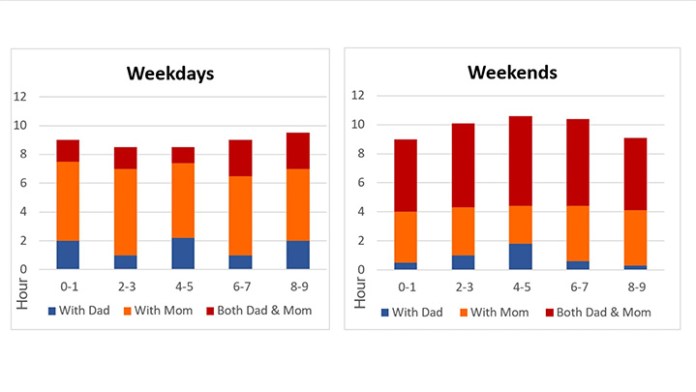
The chart below gives information about the amount of time children spend with their parents.
Sample Response
The bar chart compares how much time children of multiple age groups spend with their parents, as displayed by the amounts of time that children spend with each parent alone and both parents together.
In general, children of all age groups spend more time with their mother than their father alone throughout the week. On the weekends, children’s time with parents increases and this time is predominantly spent with both parents, rather than with each parent separately.
For the weekdays, children typically spend around 7 hours with their mother alone. Infants, in particular, have almost 8 hours which strictly involve their mother, which is more or less the same amount of time for children in the 2-3 and 6-7 age group in this regard. The time spent exclusively with their father, on the other hand, is rather limited, which is at most above 2 hours for the 4-5 age group and at least 1 hour for the 2-3 age group.
Regarding the weekends, the amount of time that children spend with both parents, which is no more than 2 hours during the weekdays, becomes roughly 5.5 hours on average on weekends. This is at the expense of the amount of time that is spent exclusively with mothers and fathers, lowering to an average of 3.8 hours and sub-1 hour respectively. Finally, children from the age of 2 to 7 spend an increased total of around 10 hours with their parents on weekends.
IELTS Writing Correction
- 1. Use singular amount Original: amounts Suggested revision: amount Why it matters: A singular uncountable form is more natural for the overall quantity being compared.
- 2. Correct weekday values Original: around 7 hours with their mother alone Suggested revision: around 5–6 hours with their mother alone Why it matters: The weekday orange segments show roughly five to six hours with mothers alone, not seven.
- 3. State the maximum clearly Original: at most above 2 hours Suggested revision: highest at just over 2 hours Why it matters: The chart shows the father-only figure peaking at just over two hours for ages 4–5.
- 4. Identify both minima Original: at least 1 hour for the 2-3 age group Suggested revision: lowest at about 1 hour for the 2–3 and 6–7 age groups Why it matters: Both the 2–3 and 6–7 groups spend about one weekday hour with fathers alone.
- 5. Correct weekday maximum Original: no more than 2 hours during the weekdays Suggested revision: no more than about 2.5 hours on weekdays Why it matters: The both-parents segment reaches roughly two and a half hours for the older weekday groups.
- 6. Correct the average Original: 3.8 hours Suggested revision: about 3.4 hours Why it matters: The five weekend mother-only values average closer to 3.4 hours than 3.8.
- 7. Fix participle choice Original: lowering Suggested revision: falling Why it matters: Use an intransitive participle because the amounts themselves decrease.
- 8. Specify the groups Original: children of multiple age groups Suggested revision: children in five age groups Why it matters: The chart presents five clearly defined age groups rather than an unspecified multiple.
- 9. Use a direct link Original: as displayed by Suggested revision: showing Why it matters: A direct participle makes the description more concise and easier to follow.
- 10. Remove redundancy Original: both parents together Suggested revision: both parents Why it matters: Both already conveys that the parents are together in this category.
- 11. Use concise time wording Original: On the weekends Suggested revision: At weekends Why it matters: This is a more concise way to introduce the weekend comparison.
- 12. Clarify the reference Original: this time is predominantly spent Suggested revision: most of this time is spent Why it matters: The revision makes the proportion relationship more explicit.
Suggested Rewrites
- amounts amount
- around 7 hours with their mother alone around 5–6 hours with their mother alone
- at most above 2 hours highest at just over 2 hours
- at least 1 hour for the 2-3 age group lowest at about 1 hour for the 2–3 and 6–7 age groups
- no more than 2 hours during the weekdays no more than about 2.5 hours on weekdays
- 3.8 hours about 3.4 hours
Why this response received Band 7.0
The response is clearly organised and provides a useful overview contrasting weekdays with weekends, especially the greater role of both parents at weekends. Its main weakness is data accuracy: several weekday figures are read from cumulative bar heights rather than the individual mother-only segments, and the weekday both-parent maximum is understated. Prioritise reading each stacked segment separately and verify every selected value against the scale before making comparisons.
IELTS Writing Criteria Scores
Task Achievement
The overview identifies the main weekday-weekend contrast, but several weekday values confuse cumulative bar heights with individual segments.
Read each coloured segment separately and correct the mother-only figures and the weekday maximum for time with both parents.
Coherence and Cohesion
The response progresses logically from an overview to weekday and weekend details, with generally clear referencing and comparison.
Make a few long comparative sentences more direct so that each numerical relationship is immediately clear.
Lexical Resource
A sufficiently flexible range describes comparison and change, although expressions such as 'strictly involve' and 'sub-1 hour' are awkward.
Use more natural statistical phrases such as 'spent with the mother alone' and 'less than one hour.'
Grammatical Range and Accuracy
Varied complex structures are mostly controlled, with only occasional awkward clauses and agreement choices that do not impede meaning.
Simplify relative clauses such as 'which is at most above 2 hours' and check singular-plural agreement in age-group references.
Write this task while it is fresh
Try the same task now. It helps you remember the feedback and write better next time.
IELTS Academic Writing Task 1
The chart below gives information about the amount of time children spend with their parents.
Your response
Write the task yourself, then compare your choices with the annotated response.