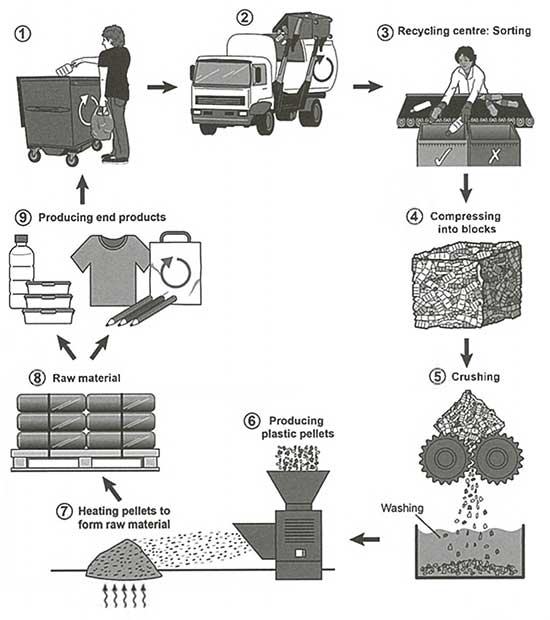
The diagram below shows the process for recycling plastic bottles.
Sample Response
The diagram illustrates how plastic bottles are recycled.
Overall, the recycling of plastic bottles is a man-made, cyclical process that consists of use, collection, sorting, crushing, cleaning, pelletizing, making new plastic products, and reuse.
After plastic bottles are used, they are discarded in recycling bins, waiting for trucks to transport them to a recycling plant. Once there, they are sorted and those that can be reused are compressed into blocks. The blocks are then broken down by a crushing machine into small pieces, which are subsequently cleaned to remove any residue.
The small clean pieces produced in the last stage are then poured into a machine where they are turned into pellets. The machine also heats and melts the pellets, which creates plastic raw material. Finally, the raw material is made into different plastic products, including pens, bottles, and reusable shopping bags. After these products are used, they go through the recycling process all over again.
IELTS Writing Correction
- 1. Name opening stages Original: use Suggested revision: disposal Why it matters: The depicted process begins when bottles are put into recycling bins before collection.
- 2. Clarify sorting outcome Original: those that can be reused Suggested revision: the suitable bottles Why it matters: The sorting stage selects bottles that can continue through recycling, while unsuitable items are removed.
- 3. Use concise process verb Original: broken down by a crushing machine Suggested revision: crushed Why it matters: Crushed expresses the depicted mechanical stage more directly.
- 4. Match depicted stage Original: cleaned to remove any residue Suggested revision: washed Why it matters: The diagram labels this stage as washing without specifying the purpose or a particular residue.
- 5. Use precise reference Original: produced in the last stage Suggested revision: produced after washing Why it matters: Naming the preceding stage makes the sequence easier to follow than the vague reference last stage.
- 6. Name pellet stage Original: poured into a machine Suggested revision: fed into a pellet-making machine Why it matters: This wording identifies both the action and the machine's function more precisely.
- 7. Sentence rewrite Original: The machine also heats and melts the pellets, which creates plastic raw material. Suggested revision: The pellets are then heated to form plastic raw material. Why it matters: Heating is shown as a separate stage after pellet production, not as another action performed by the pellet-making machine.
- 8. Group the main phases Suggested revision: Summarise the cycle through its main phases—collection and sorting, material processing, and manufacture of new products—rather than listing nearly every action. Why it matters: Grouping the stages would make the overview more selective while preserving the cyclical feature.
Suggested Rewrites
- use disposal
- those that can be reused the suitable bottles
- broken down by a crushing machine crushed
- cleaned to remove any residue washed
- produced in the last stage produced after washing
- poured into a machine fed into a pellet-making machine
Why this response received Band 8.0
The response gives a clear, logically sequenced account of the complete recycling process, supported by an effective overview and precise stage-by-stage description. The main limitation is slight imprecision in describing sorted bottles as items that can be reused and in compressing the heating and melting stage into the pellet-making machine. Prioritize preserving the diagram's exact stage distinctions and terminology.
IELTS Writing Criteria Scores
Task Achievement
The overview identifies the cyclical nature of the process, and the body accurately covers all nine stages from disposal to new products.
Distinguish recyclable bottles from reusable items and describe pellet production and heating as clearly separate stages.
Coherence and Cohesion
The stages are ordered naturally across well-proportioned paragraphs, with cohesive links that make the sequence easy to follow.
Retain this chronological structure while making the transition from cleaning to pellet production even more explicit.
Lexical Resource
Vocabulary is varied and precise for a process description, including sorting, compressed, residue, pellets, and raw material.
Prefer recyclable or accepted bottles over those that can be reused to match the sorting stage more exactly.
Grammatical Range and Accuracy
A wide range of passive and complex structures is used accurately, with only minor stylistic awkwardness.
Continue varying passive structures while ensuring each machine or stage has an unambiguous grammatical subject.
Write this task while it is fresh
Try the same task now. It helps you remember the feedback and write better next time.
IELTS Academic Writing Task 1
The diagram below shows the process for recycling plastic bottles.
Your response
Write the task yourself, then compare your choices with the annotated response.