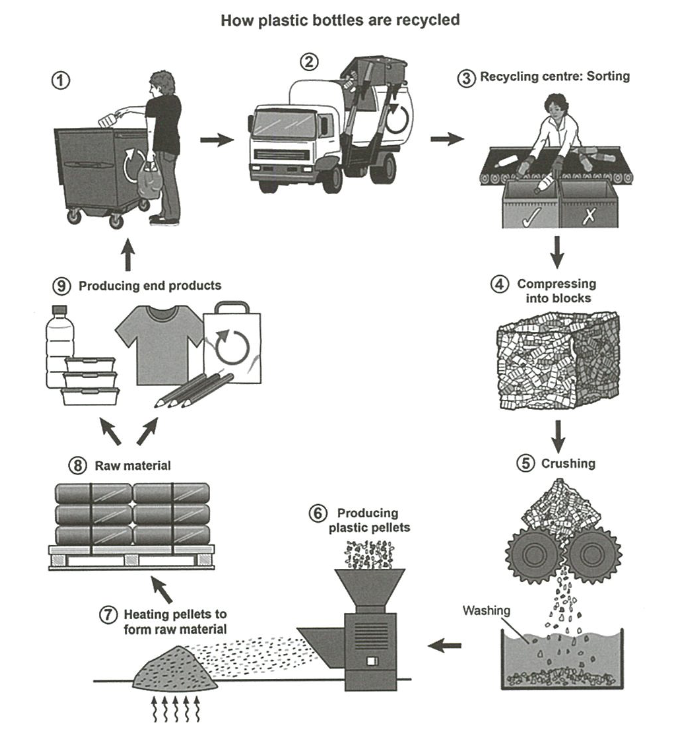
The diagram below shows the process for recycling plastic bottles.
Sample Response
The diagram depicts the sequential process involved in recycling plastic bottles.
As is observed, the recycling of plastic bottles is a cyclical and multi-stage process that begins with people discarding used plastic bottles and ends with the production of new plastic items. The process highlights the systematic transformation of plastic waste into reusable goods.
Initially, when used plastic bottles are discarded into recycling bins by end-users, they are collected by garbage trucks, which transport those bottles to a recycling facility. At the facility, workers sort out recyclable ones from non-recyclable waste. The selected plastic bottles are then compressed into blocks using compacting equipment. Following this, the compacted blocks are shredded into small plastic fragments, which are subsequently washed to remove impurities. The clean plastic pieces are then poured into machines to produce plastic pellets. In the next step, those pellets are heated and processed to turn them into raw materials. These raw materials are then ready to be used to manufacture a wide variety of plastic products such as clothes, containers, and bottles. Once those goods are used and discarded in garbage bins, the plastic recycling process is repeated.
IELTS Writing Correction
- 1. Use a direct overview Original: As is observed Suggested revision: Overall Why it matters: A direct overview marker introduces the main process summary more clearly.
- 2. Use natural wording Original: end-users Suggested revision: consumers Why it matters: Consumers is the more natural term for the people shown disposing of bottles.
- 3. Name the sorted items Original: sort out recyclable ones Suggested revision: separate recyclable bottles Why it matters: The replacement avoids the unclear pronoun and describes the sorting stage precisely.
- 4. Match the labelled stage Original: shredded into small plastic fragments Suggested revision: crushed into small plastic pieces Why it matters: The visual labels this stage as crushing rather than shredding.
- 5. Use precise process wording Original: poured into machines Suggested revision: fed into a machine Why it matters: Fed into a machine is a more precise description of the mechanised pellet-making stage.
- 6. Describe stage seven precisely Original: heated and processed to turn them into raw materials Suggested revision: heated to form raw material Why it matters: The diagram specifically shows the pellets being heated to form raw material.
- 7. Use the mass noun Original: These raw materials Suggested revision: This raw material Why it matters: Raw material is presented as an uncountable product at this stage.
- 8. Keep the cycle accurate Original: garbage Suggested revision: recycling Why it matters: The return arrow leads to the recycling bin shown at the start of the process.
- 9. Split the stage sequence Suggested revision: Divide the long stage description into two logical paragraphs, separating collection and sorting from material processing and final production. Why it matters: A paragraph break would make the nine-stage sequence easier to follow.
Suggested Rewrites
- As is observed Overall
- end-users consumers
- sort out recyclable ones separate recyclable bottles
- shredded into small plastic fragments crushed into small plastic pieces
- poured into machines fed into a machine
- heated and processed to turn them into raw materials heated to form raw material
Why this response received Band 8.5
The response presents the full recycling sequence accurately and clearly, with an effective overview and strong control of progression and language. Its main limitation is that a few descriptions are slightly generic; the best refinement is to match every stage and output even more precisely to the visual while retaining the current concise structure.
IELTS Writing Criteria Scores
Task Achievement
A clear overview and a complete, accurate account cover all nine stages from disposal to the production of new goods.
Preserve this comprehensive coverage while matching every transformation and output to the diagram’s precise labels.
Coherence and Cohesion
Information progresses smoothly through a well-organised introduction, overview, and chronological description with unobtrusive linking.
Maintain the clear stage-by-stage sequence while trimming any framing that does not advance the process description.
Lexical Resource
A wide and precise process vocabulary, including compressed, shredded, pellets, and raw materials, is used naturally throughout.
Refine the few generic expressions by choosing the most exact process verb available for each illustrated stage.
Grammatical Range and Accuracy
A wide range of complex structures is handled accurately, with clear reference and almost no noticeable error.
Continue varying clause patterns while keeping long process sentences as controlled and readable as they are here.
Write this task while it is fresh
Try the same task now. It helps you remember the feedback and write better next time.
IELTS Academic Writing Task 1
The diagram below shows the process for recycling plastic bottles.
Your response
Write the task yourself, then compare your choices with the annotated response.