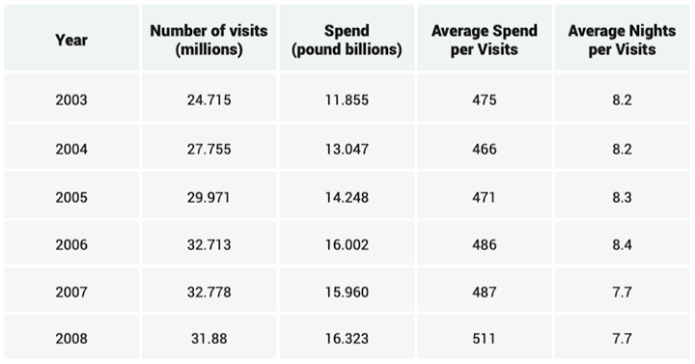
The table below shows the number of visitors in the UK and their average spending from 2003 to 2008.
Sample Response
The table gives information about the number of people who visited the UK from 2003 to 2008, as well as the average duration of their stay and amount of money they spent whilst there.
Overall, the figures for all statistics grew over the time period, except for the average duration of stay which declined slightly.
In 2003, the UK received approximately 24.7 million visitors who spent around £11.9 billion. The number of visitors continued to rise each year until peaking at approximately 32.8 million in 2007, and dropping slightly to approximately 31.9 million in 2008. The amount of money spent also rose most years, peaking at £16.3 billion in 2008.
The average duration that visitors stayed in 2003 was 8.2 nights, while they spent an average of £475 per visit. The average number of nights per visit rose slightly until 2006, before declining to an average of 7.7 nights in 2007 and 2008. The average amount of money spent per visit tended to fluctuate each year, but peaked in 2008 at £511.
IELTS Writing Correction
- 1. Use concise reporting Original: The table gives information about Suggested revision: The table presents Why it matters: This concise reporting verb makes the introduction more direct.
- 2. Report visits accurately Original: the number of people who visited Suggested revision: the number of visits to Why it matters: The table measures visits, which need not equal the number of individual visitors.
- 3. Clarify the reference Original: whilst there Suggested revision: during their visits Why it matters: The revision identifies the period more precisely.
- 4. Use natural collocation Original: statistics Suggested revision: measures Why it matters: Measures is a more natural term for the four variables in the table.
- 5. Simplify the sequence Original: continued to rise each year until peaking Suggested revision: rose each year and peaked Why it matters: The finite verbs express the sequence more directly.
- 6. Fix sequence grammar Original: and Suggested revision: before Why it matters: Before correctly links the decline in 2008 to the preceding peak.
- 7. Name total spending Original: The amount of money spent also rose most years Suggested revision: Total spending also rose in most years Why it matters: This wording distinguishes total expenditure from average spending per visit.
- 8. Use standard phrase Original: duration that visitors stayed Suggested revision: length of visitors' stays Why it matters: Length of stay is the standard and more concise expression for this measure.
- 9. Sentence rewrite Original: The average amount of money spent per visit tended to fluctuate each year, but peaked in 2008 at £511. Suggested revision: Average spending per visit fell from £475 in 2003 to £466 in 2004, then rose each year to a peak of £511 in 2008. Why it matters: The data show one initial fall followed by steady annual increases, rather than repeated fluctuation.
Suggested Rewrites
- The table gives information about The table presents
- the number of people who visited the number of visits to
- whilst there during their visits
- statistics measures
- continued to rise each year until peaking rose each year and peaked
- and before
Why this response received Band 8.0
The response is concise, well organised, and consistently accurate in its presentation of the principal figures and overall directions. Its main limitation is that the overview slightly simplifies the fluctuating pattern in average spending per visit and the detail focuses heavily on endpoints. The highest-priority improvement is to distinguish overall growth from year-to-year fluctuation and highlight one or two informative intermediate changes.
IELTS Writing Criteria Scores
Task Achievement
The response gives a clear overview and accurately selects key values for all four measures, though some intermediate variation is compressed.
Clarify that average spending per visit fluctuated despite ending higher, and include a salient intermediate comparison.
Coherence and Cohesion
The progression from overview to total figures and then per-visit measures is clear, logical, and easy to follow.
Strengthen the link between the overview and details by grouping the two fluctuating measures more explicitly.
Lexical Resource
A strong range of precise trend and measurement vocabulary is used naturally with only slight repetition.
Replace repeated uses of average and peaked where possible with equally precise alternatives.
Grammatical Range and Accuracy
Sentence structures are varied and controlled, with accurate complex clauses and punctuation throughout.
Refine the slightly awkward phrase the average duration that visitors stayed into a more concise noun phrase.
Write this task while it is fresh
Try the same task now. It helps you remember the feedback and write better next time.
IELTS Academic Writing Task 1
The table below shows the number of visitors in the UK and their average spending from 2003 to 2008.
Your response
Write the task yourself, then compare your choices with the annotated response.