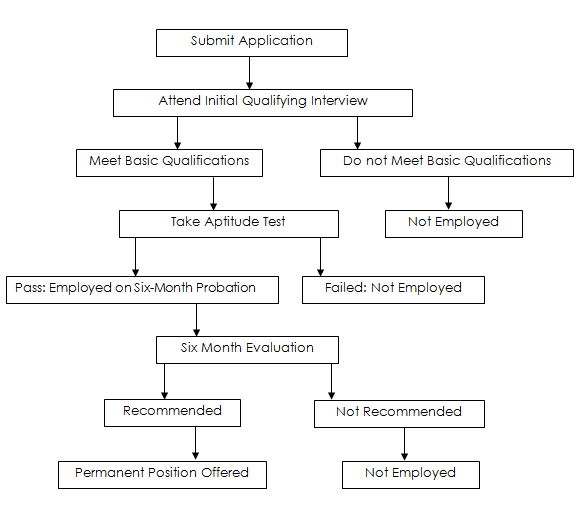
The diagram below shows the steps in the hiring process at ACME corporation. ACME Corporation: Recreuitement Process.
Sample Response
The flow chart shows the steps followed by the ACME Corporation to recruit new employees. A quick glance at the process reveals that an applicant has to qualify in different stages to be permanently employed in this organisation. As is observed, the recruitment process commences with the invitation to prospective candidates to submit their applications. These applicants are then called for an initial qualifying interview which determines whether they meet the basic requisites or not. Failing in this interview does not qualify some candidates for any further process, while successful applicants sit for an aptitude test in the next level. As for the aptitude test, passing it leads to a probationary job placement for six months but those who fail are then rejected. An evaluation stage is followed by the six-month probation period which determines whether applicants would be offered a permanent position while the non-recommended temporary employees would be discarded from the job.
IELTS Writing Correction
- 1. Remove company article Original: the ACME Corporation Suggested revision: ACME Corporation Why it matters: A company name used as a proper noun does not require the here.
- 2. Use concise hiring verb Original: recruit Suggested revision: hire Why it matters: Hire expresses the complete recruitment outcome more directly.
- 3. Use formal overview marker Original: A quick glance at the process reveals Suggested revision: Overall Why it matters: Overall is a concise academic marker for the process summary.
- 4. Use natural stage phrase Original: qualify in different stages Suggested revision: succeed at several stages Why it matters: Applicants succeed at stages rather than qualify in them.
- 5. State final outcome Original: to be permanently employed Suggested revision: to secure permanent employment Why it matters: Secure permanent employment expresses the endpoint more naturally.
- 6. Use accurate passive Original: called for an initial qualifying interview Suggested revision: required to attend an initial qualifying interview Why it matters: The diagram shows attendance as the next required step rather than a telephone call.
- 7. Use diagram terminology Original: basic requisites or not Suggested revision: the basic qualifications Why it matters: Basic qualifications matches the process label and makes or not unnecessary.
- 8. Use stage sequence Original: in the next level Suggested revision: at the next stage Why it matters: At the next stage is the natural phrase for process sequencing.
- 9. Name the stage clearly Original: As for the aptitude test Suggested revision: At the aptitude-test stage Why it matters: The revision creates a direct transition to the next process stage.
- 10. Use concise employment term Original: probationary job placement for six months Suggested revision: six-month probationary position Why it matters: The revised phrase is shorter and matches the diagram's probationary employment stage.
- 11. Use concise process phrase Original: shows the steps followed by Suggested revision: illustrates the stages used by Why it matters: The revision describes the flowchart's function more directly.
- 12. Use concise company reference Original: in this organisation Suggested revision: at the company Why it matters: At the company is a more concise reference to the employer.
Suggested Rewrites
- the ACME Corporation ACME Corporation
- recruit hire
- A quick glance at the process reveals Overall
- qualify in different stages succeed at several stages
- to be permanently employed to secure permanent employment
- called for an initial qualifying interview required to attend an initial qualifying interview
Why this response received Band 7.0
The response follows the complete recruitment pathway, including every decision point and rejection branch, and uses precise process vocabulary to make the sequence easy to understand. The main weakness is occasional awkward or ambiguous phrasing, especially the passive sentence about probation and evaluation, which appears to reverse their order. Prioritise unambiguous sequencing language and organise the overview and stages into separate paragraphs.
IELTS Writing Criteria Scores
Task Achievement
The response accurately covers the process from application through interview, testing, probation, evaluation, and the final employment outcomes.
State explicitly that the six-month evaluation occurs after probation so the final sequence cannot be misread.
Coherence and Cohesion
The stages and alternative outcomes progress logically, but the one-paragraph presentation gives the overview and details insufficient separation.
Use an introduction and overview paragraph followed by a detail paragraph tracing the successful route and its rejection branches.
Lexical Resource
Vocabulary is varied and largely precise for the hiring process, with effective terms such as 'prospective', 'requisites', 'aptitude', and 'probationary'.
Replace awkward phrases such as 'discarded from the job' and 'in the next level' with 'not employed' and 'at the next stage'.
Grammatical Range and Accuracy
A good range of complex structures is generally well controlled, although a few passive and clause constructions are awkward or ambiguous.
Use the active sequence 'After six months of probation, candidates are evaluated' to avoid reversing the order of stages.
Write this task while it is fresh
Try the same task now. It helps you remember the feedback and write better next time.
IELTS Academic Writing Task 1
The diagram below shows the steps in the hiring process at ACME corporation. ACME Corporation: Recreuitement Process.
Your response
Write the task yourself, then compare your choices with the annotated response.