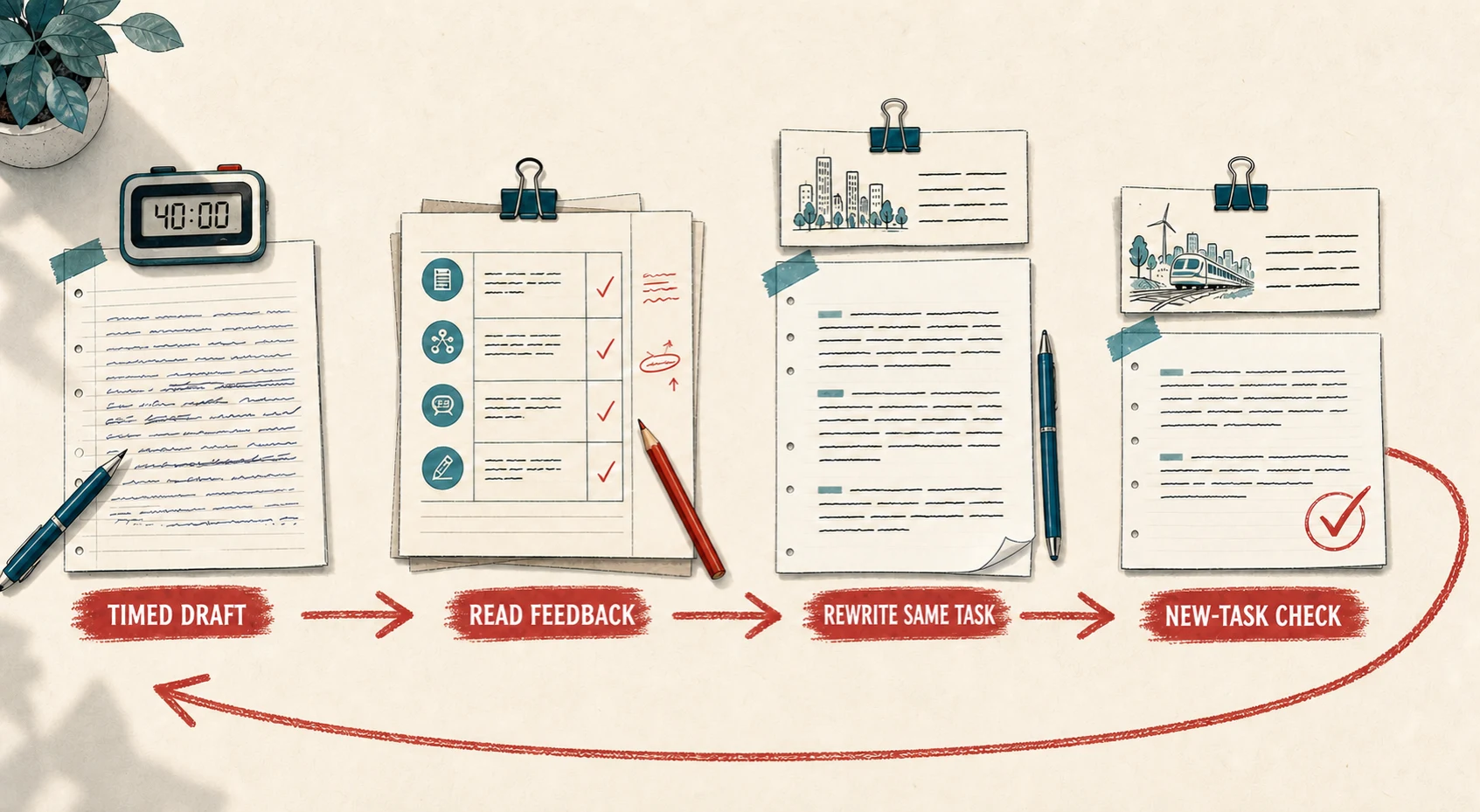
Use one task for a complete feedback loop
Writing a new essay every day can increase output, but it does not guarantee that you will fix the problems in your previous response. Writing the same task twice creates a simple loop: perform, receive feedback, and apply it while the task is still familiar.
Here, ‘twice’ means one original draft and one full rewrite. It is a practical minimum supported by research on second-language writing repetition; it is not a universal magic number.
Why two drafts? What the research actually supports
A 2025 meta-analysis of 17 studies and 442 participants found a small positive overall effect of task repetition on second-language writing. Fluency improved most clearly, while accuracy and lexical complexity also improved. The authors reported that repetition count did not reliably change the effect and suggested that one repetition can be sufficient. That maps neatly to two drafts: the first attempt plus one rewrite.
A second 2025 meta-analysis covering 31 studies found positive effects across accuracy, lexical complexity, fluency, and syntactic complexity. It also found that more repetitions generally produced larger effects and that feedback particularly helped accuracy. Taken together, the evidence supports starting with one rewrite while leaving room for extra repetition when a recurring problem remains.
These studies examine second-language writing broadly rather than IELTS scores specifically. Use the method as a learning routine, not as a promise of a fixed score increase.
First draft: capture your real timed performance
Choose an unseen question from the Task 2 practice question library or the Academic Task 1 practice question library. Complete it without reading a sample answer first. Use about 40 minutes for Task 2 or 20 minutes for Task 1.
Submit the response to IELTS Writing Checker and record the estimated overall score, the four criterion scores, and the most important next step. Pick one or two priorities for the rewrite. Trying to repair every weakness at once makes the second draft hard to control.
Save these before rewriting
- The original task and your timed first draft.
- One task-response or organisation priority.
- One repeated vocabulary or grammar problem.
Second draft: rewrite the same task from the beginning
Read the criterion feedback and inline corrections, then close the first draft. Open a blank editor and answer the same question again in full. Rebuilding the response makes you retrieve the better decisions yourself.
Use the feedback in this order
- Fix task coverage first: answer every part of the question and make the position or overview explicit.
- Rebuild paragraph logic: give each paragraph one clear job and develop the main point with relevant explanation or comparison.
- Repair repeated language errors: use the inline original, suggestion, and explanation to correct patterns that appear more than once.
- Submit the second draft and compare it with the first report criterion by criterion.
The 2025 repetition meta-analysis found especially favourable results around a one-week interval. One week is a useful starting point when your schedule allows it; a shorter interval is still workable during an intensive preparation period.
Keep the first and second reports in your correction history. The comparison is more useful when both drafts use the same prompt because topic difficulty is held relatively steady.
How do you know the practice worked? Use one similar new task
A higher result on the rewritten task is encouraging, but the stronger test is a fresh question of the same type. Research with 114 Chinese-speaking L2 students found that rubric and exemplar feedback improved both the current task and a new, similar writing task.
After the rewrite, choose one unseen question and write it under timed conditions. Use the IELTS Writing band descriptors and official scored samples to check whether the same improvement appears without the familiar prompt.
Look for three signs
- The priority from draft one is handled without prompting.
- The same language error occurs less often.
- The new answer remains complete within the time limit.
IELTS Writing practice questions
How many times should I write the same IELTS Writing task?
Start with two drafts: one original attempt and one complete rewrite. Current research supports task repetition but does not establish one universal optimum. Add another repetition only when the same important problem remains.
How long should I wait between the two drafts?
A 2025 meta-analysis found particularly favourable results with a one-week interval. Treat one week as a useful starting point, not a compulsory rule. During intensive preparation, a one-day interval is still practical.
Can I read a sample answer before the second draft?
Review feedback and relevant scored samples after the first attempt. Before rewriting, close the sample and rebuild the answer in your own words so the second draft tests retrieval and decision-making.
Practice resources and research
Use a real question, criterion-based feedback, and a saved comparison for the two-draft cycle.