What is Cambridge IELTS?
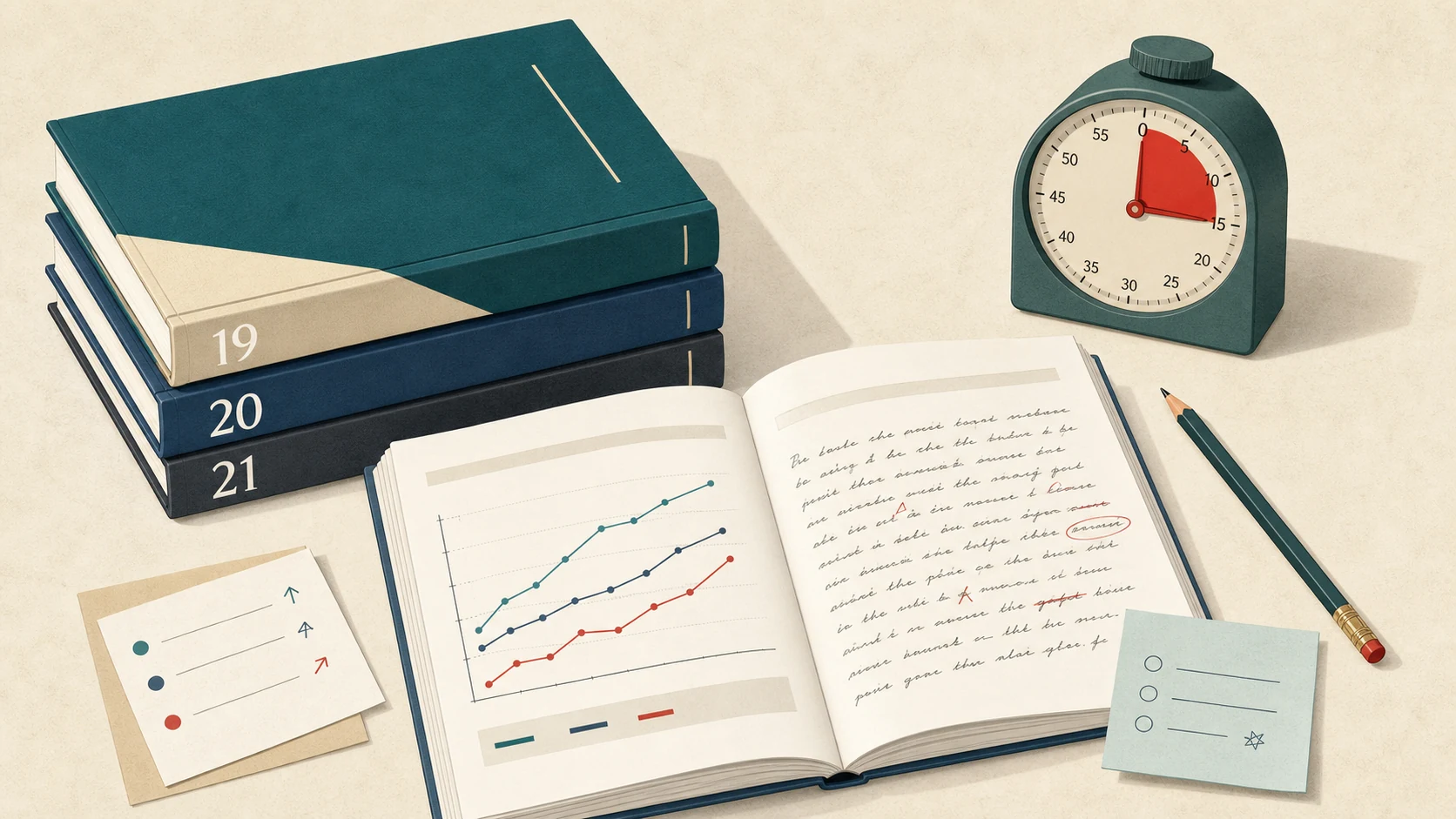
When learners say ‘Cambridge IELTS’ or ‘Cambridge books’, they usually mean the Cambridge IELTS practice-test series. Each recent book contains four complete tests covering Listening, Reading, Writing, and Speaking, together with answer keys, audio scripts, and Writing samples.
Cambridge University Press & Assessment publishes the series and is one of the organisations that jointly manages IELTS. The tests therefore give you a more dependable picture of the real test than most unofficial mock papers.
The books are practice tests, not a complete course. They can show you the format and reveal weaknesses, but they do not teach grammar, vocabulary, or essay structure from the beginning.
Why is Cambridge IELTS so important?
Its first value is realism. Unofficial mock tests can vary greatly in style and difficulty. Cambridge IELTS gives you a steadier reference for the question types, timing, instructions, and level of detail you will face.
Its second value is diagnosis. A slow Reading score may come from locating information too slowly. A weak Writing result may come from an incomplete response rather than a lack of advanced vocabulary. Reviewing a Cambridge test helps you identify the exact problem instead of simply recording a score.
It also helps you build judgement under time pressure: which questions to move through quickly, where to slow down, and what a complete Writing response needs to achieve.
Which Cambridge IELTS books should you practise?
You do not need to start at Cambridge IELTS 1 and work through every book. For most learners, the recent books should form the core of the plan, with Cambridge IELTS 21 receiving priority as the newest volume.
| Preparation time | Books to practise | Complete tests | Suggested approach |
|---|---|---|---|
| 2–4 weeks | Cambridge IELTS 20–21 | 8 tests | Complete two to four tests each week, depending on your timeline, and keep one test from Book 21 for a final mock. |
| 1–2 months | Cambridge IELTS 19–21 | 12 tests | Practise individual skills first, then move to timed complete tests. |
| 3 months or more | Cambridge IELTS 17–21 | 20 tests | Limit yourself to two carefully reviewed tests a week instead of rushing through them. |
If you are taking the test for university study or professional registration, use the Academic edition. Start with our Cambridge IELTS 21 Academic Writing questions and scored samples.
If you are taking the test for migration or certain non-degree programmes, use General Training. Start with our Cambridge IELTS 21 General Training Writing questions and scored samples.
Listening and Speaking follow the same format in both modules, but Reading and Writing differ. Academic Task 1 uses charts, maps, and processes; General Training Task 1 is a letter. Do not mix the two Writing modules.
How should you use Cambridge IELTS to improve Writing?
The most useful material is not only the question. It is the combination of the task, the scored response, and the examiner comments. Our Cambridge IELTS official Writing sample list brings together 64 official samples from Cambridge IELTS 18–21 across Academic and General Training.
Browse Cambridge IELTS Writing samplesA three-step Writing routine
- Write first. Complete Task 1 in about 20 minutes or Task 2 in about 40 minutes before reading any sample.
- Compare next. Check whether the response covers the whole task, what each paragraph does, and why the examiner praises or criticises specific choices.
- Rewrite last. Fix the task response, organisation, vocabulary, and grammar problems that the comments reveal, while keeping your own ideas.
Use the score and examiner comments together to identify what held the response at that level: incomplete task coverage, weak development, unclear organisation, imprecise vocabulary, or frequent grammar errors. Focus on the reason for the score instead of collecting impressive phrases.
One complete write–compare–rewrite cycle usually teaches you more than producing several new essays without reviewing them.
Common mistakes when using Cambridge IELTS
Most learners lose value from the books in a few predictable ways:
- Counting completed tests instead of analysing repeated mistakes.
- Memorising sample essays as fixed templates for unrelated questions.
- Reading only high-scoring responses and ignoring examiner comments on weaker work.
- Using a test you have already repeated to estimate your current level.
- Finishing every recent test too early and leaving no unseen paper for a final mock.
Use Cambridge IELTS as a measuring tool, not a checklist
Choose the correct Academic or General Training module, focus on the recent books, and match the number of tests to the time you actually have. Most importantly, review every test and use the official Writing samples to understand why an answer works—or does not.
The goal is not to say that you have finished Cambridge IELTS. It is to enter the real test able to recognise the task, manage the time, and produce a complete response.