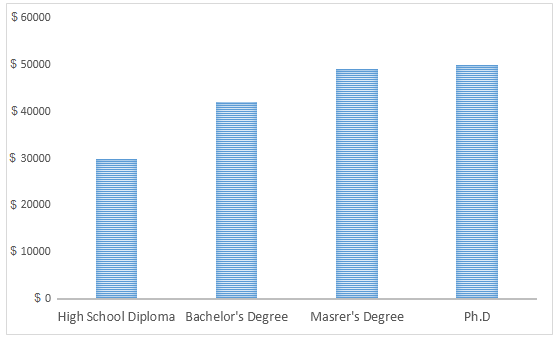
The graph below shows the average salaries earned by people with different levels of education. Average Salaries Earned by People with Different Levels of Education
Sample Response
The provided bar chart compares salaries earned by people based on their educational qualification. As an overall trend, those who have higher degrees generally earn more and post-graduates or more qualified professionals earn around 60% to 70% higher wages annually than high school diploma holders To begin with, people who have a high school diploma receive 30 thousand dollars annual salary, on average. Job holders with Bachelor's degrees are entitled to get 10 thousand more as remuneration. Additionally, Master's Degree allows an average person to earn as much as 49 thousand dollars in a year, while for PhD, the payroll increases to over 50 thousand dollars a year, which is more than 20 and around 10 thousand dollars higher than that of high school diploma and Bachelor degree holders, respectively. It is worth noticing that people with Master's Degree or PhD earn over 20 thousand dollars more than those with just school certificates. Also, the difference in earnings between two close levels of education gradually become smaller.
IELTS Writing Correction
- 1. Use plural noun Original: qualification Suggested revision: qualifications Why it matters: The chart compares several people and several qualification levels.
- 2. Match chart categories Original: post-graduates or more qualified professionals Suggested revision: people with postgraduate qualifications Why it matters: The chart classifies people by education level rather than by professional status.
- 3. Separate sentences Original: holders To begin Suggested revision: holders. To begin Why it matters: A full stop is needed between the overview and the detailed description.
- 4. Fix salary phrase Original: 30 thousand dollars annual salary Suggested revision: an annual salary of 30 thousand dollars Why it matters: The noun phrase requires an article and an “of” construction.
- 5. Use precise verb Original: are entitled to get Suggested revision: earn Why it matters: “Earn” describes the salary relationship more directly and accurately.
- 6. State currency unit Original: 10 thousand more as remuneration Suggested revision: 10 thousand dollars more Why it matters: The comparative amount needs its currency unit.
- 7. Use adjacent levels Original: two close levels of education Suggested revision: adjacent levels of education Why it matters: “Adjacent” precisely identifies neighbouring categories on the chart.
- 8. Fix agreement Original: become Suggested revision: becomes Why it matters: The singular subject “difference” requires the singular verb “becomes”.
- 9. Use human subject Original: higher degrees generally earn more Suggested revision: people with higher degrees generally earn more Why it matters: People earn salaries; qualifications themselves do not earn money.
- 10. Clarify annual salaries Original: 60% to 70% higher wages annually Suggested revision: annual salaries about 60% to 70% higher Why it matters: This word order states the annual comparison more naturally.
- 11. Use concise category Original: people who have a high school diploma Suggested revision: high school diploma holders Why it matters: This concise noun phrase matches the chart's category label.
- 12. Use earn Original: receive Suggested revision: earn Why it matters: “Earn” is the more direct verb for reporting salary.
Suggested Rewrites
- qualification qualifications
- post-graduates or more qualified professionals people with postgraduate qualifications
- holders To begin holders. To begin
- 30 thousand dollars annual salary an annual salary of 30 thousand dollars
- are entitled to get earn
- 10 thousand more as remuneration 10 thousand dollars more
Why this response received Band 6.5
The response presents a clear upward relationship between education and salary, with a useful overview and coverage of every qualification level. Its main weakness is imprecision in several comparisons—such as describing the bachelor's increase as $10,000 and the PhD salary as over $50,000—alongside some awkward wording and sentence control. Prioritise exact values and differences, then proofread punctuation, agreement, and article use.
IELTS Writing Criteria Scores
Task Achievement
The overview accurately captures the positive relationship and the response covers all four education levels, though several differences are only approximate.
Report the exact figures of about $30,000, $42,000, $49,000, and $50,000 and calculate comparisons directly from them.
Coherence and Cohesion
The report follows a logical overview-to-detail progression and uses comparisons effectively, but the single-paragraph presentation and missing sentence break reduce clarity.
Place the overview in its own paragraph and begin "To begin with" as a clearly punctuated detail paragraph.
Lexical Resource
Vocabulary is varied and generally appropriate, including language for qualifications, earnings, and comparisons, although some choices are awkward or overstated.
Prefer precise neutral terms such as "earn," "annual salary," and "degree holders" instead of "are entitled to get" or "payroll increases."
Grammatical Range and Accuracy
The response uses varied complex structures with mostly clear meaning, but punctuation, agreement, articles, and possessive forms contain noticeable errors.
Proofread sentence boundaries and forms such as "an annual salary," "bachelor's degree holders," and "the difference becomes smaller."
Write this task while it is fresh
Try the same task now. It helps you remember the feedback and write better next time.
IELTS Academic Writing Task 1
The graph below shows the average salaries earned by people with different levels of education. Average Salaries Earned by People with Different Levels of Education
Your response
Write the task yourself, then compare your choices with the annotated response.