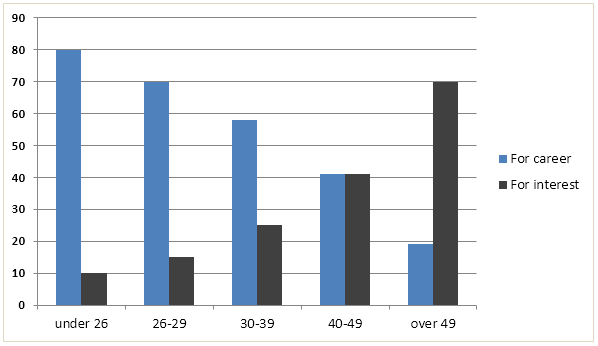
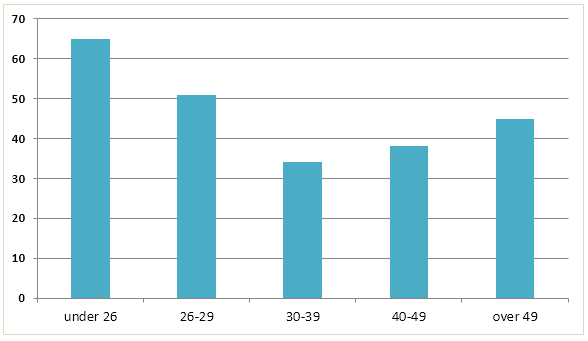
The charts below show the main reasons for study among students of different age groups and the amount of support they received from employers.
Sample Response
The diagrams outline why students from different age groups study and the support they received from their employers.
Overall, having a good career is the main reason for young to study while it is personal interest for grown-ups. Moreover, young employees got more support from their employers regarding their education. According to the first bar graph, people who are under 40 years old mostly study for the career while people over 49 years mainly study for their interest. Interestingly for the age group 40 to 49, the number of people who study for career and the number of people who study for interest is the same. 80% students under 26 years continue their education to build a career. Seven out of ten students over 49 years old do so for their interest, rather than their career. The second bar graph shows that more than 60% students under 26 years old got support from their employers for their education and this supports included the time off and monetary support. This percentage of support reduced with the increase of age of the learners, and at 30-39 age group, 32% got the support from the employers. After that, the employers’ support for their employees’ education increased and reached to 45% for the over 49 year’s age group.
IELTS Writing Correction
- 1. Keep tense consistent Original: received Suggested revision: receive Why it matters: The charts present general data, so present tense is more consistent.
- 2. Add noun after young Original: reason for young to study Suggested revision: reason for young people to study Why it matters: Young cannot stand alone as a countable group noun in this construction.
- 3. Use formal wording Original: grown-ups Suggested revision: older people Why it matters: Older people is more appropriate for a formal report.
- 4. State the peak precisely Original: young employees got more support Suggested revision: the youngest employees receive the most support Why it matters: The employer-support chart shows the under-26 group as the clear maximum.
- 5. Use natural collocation Original: study for the career Suggested revision: study for career purposes Why it matters: For the career is not a natural expression for motivation to study.
- 6. Add introductory comma Original: Interestingly for the age group Suggested revision: Interestingly, for the age group Why it matters: The introductory adverb requires a following comma.
- 7. Add article Original: study for career and Suggested revision: study for a career and Why it matters: Career is a singular countable noun here and needs an article.
- 8. Fix noun phrase Original: study for interest is Suggested revision: study out of interest are Why it matters: Out of interest is idiomatic, and the compound subject requires are.
- 9. Add of Original: 80% students Suggested revision: 80% of students Why it matters: A percentage followed by a specific noun group requires of.
- 10. Add of Original: more than 60% students Suggested revision: more than 60% of students Why it matters: Use of between a percentage and the noun it quantifies.
- 11. Use singular support Original: supports Suggested revision: support Why it matters: Support is uncountable in this context and takes a singular demonstrative.
- 12. Use intransitive verb Original: reduced Suggested revision: decreased Why it matters: Decrease is the correct intransitive verb for a falling percentage.
Suggested Rewrites
- received receive
- reason for young to study reason for young people to study
- grown-ups older people
- young employees got more support the youngest employees receive the most support
- study for the career study for career purposes
- Interestingly for the age group Interestingly, for the age group
Why this response received Band 7.0
The response gives a clear overview and accurately selects the main age-related contrasts, supported by relevant figures from both charts. Progression is logical, although the detailed discussion is compressed into one long paragraph and recurring article, agreement, and preposition errors make some phrasing awkward. The most useful improvement is to separate the two charts into focused detail paragraphs and polish comparative sentence structures while retaining the accurate data selection.
IELTS Writing Criteria Scores
Task Achievement
A clear overview and well-selected, largely accurate figures convey the opposing study motivations and the fall-then-rise pattern in employer support.
Add one comparison involving the 26–29 or 40–49 support groups to make the coverage of the second chart slightly more complete.
Coherence and Cohesion
Information progresses logically from the overview to reasons for study and then employer support, with cohesive devices used effectively despite limited paragraphing.
Place the two charts in separate detail paragraphs so each trend is easier to scan and the organisation fully reflects the content.
Lexical Resource
Vocabulary is sufficiently varied for comparisons and education-related data, but several awkward collocations and word-form choices limit precision.
Replace phrases such as study for the career and this supports included with study for career advancement and this support included.
Grammatical Range and Accuracy
The response uses a useful range of simple and complex structures, though recurring article, agreement, possessive, and preposition errors remain noticeable.
Proofread noun phrases and comparatives, especially 80% of students, this support included, increased with age, and reached 45%.
Write this task while it is fresh
Try the same task now. It helps you remember the feedback and write better next time.
IELTS Academic Writing Task 1
The charts below show the main reasons for study among students of different age groups and the amount of support they received from employers.
Your response
Write the task yourself, then compare your choices with the annotated response.