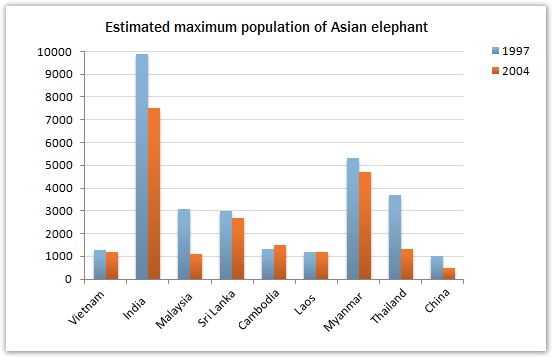
The graph below shows the changes in the maximum number of Asian elephants between 1994 and 2007.
Sample Response
The diagram outlines the population distribution of elephants in nine Asian countries in 1997 and 2004. Generally speaking, India had the highest number of elephants in both years while the total number of this species harshly declined during the period. As is presented, roughly 10000 elephants inhabited in India, the highest, which dropped to nearly 7500 in just seven years. Myanmar had the second largest number of elephants, over 5000, while China had only 1000 elephants in 1997. Their number in both countries declined and only 500 elephants were recorded in China in 2004. Malaysia and Sri Lanka had around 3000 elephants and in just 7 years, the number of elephant in the former country declined to as low as 1000. Vietnam and Laos had around a thousand elephants and the figure remained the same in Laos. The only place where elephant population grew was Cambodia where more than a thousand elephants dwelled. Finally, Thailand was the home to approximately 4 thousand elephants, which dropped to just over a thousand in merely 7 years.
IELTS Writing Correction
- 1. Name measure precisely Original: population distribution Suggested revision: estimated maximum populations Why it matters: The chart reports estimated maximum populations rather than geographic distribution.
- 2. Use correct collocation Original: harshly declined Suggested revision: declined sharply Why it matters: Sharply, not harshly, is the natural adverb for a numerical decline.
- 3. Use concise reference Original: As is presented Suggested revision: As shown Why it matters: As shown is the conventional concise phrase for referring to chart data.
- 4. Use compound adjective Original: second largest number Suggested revision: second-highest number Why it matters: Second-highest is the more natural comparative description for a ranked figure.
- 5. Format estimate clearly Original: over 5000 Suggested revision: just over 5,000 Why it matters: Just over reflects the bar's approximate value more precisely.
- 6. Format number clearly Original: only 1000 Suggested revision: about 1,000 Why it matters: About accurately signals that the chart value is approximate.
- 7. Clarify plural reference Original: Their number in both countries Suggested revision: The figures for both countries Why it matters: Two countries require the plural figures, and their has an unclear antecedent.
- 8. Use plural noun Original: elephant Suggested revision: elephants Why it matters: Elephants must be plural after number of.
- 9. Report value neutrally Original: as low as 1000 Suggested revision: about 1,000 Why it matters: About reports the approximate bar value without unnecessary emphasis.
- 10. Add definite article Original: where elephant population grew Suggested revision: where the elephant population grew Why it matters: The specific elephant population in Cambodia requires the definite article.
- 11. State Cambodia change Original: more than a thousand elephants dwelled Suggested revision: the figure rose from about 1,300 to 1,500 Why it matters: The chart shows a modest increase between the two recorded values.
- 12. Remove wrong article Original: was the home to Suggested revision: was home to Why it matters: The fixed expression is was home to without the.
Suggested Rewrites
- population distribution estimated maximum populations
- harshly declined declined sharply
- As is presented As shown
- second largest number second-highest number
- over 5000 just over 5,000
- only 1000 about 1,000
Why this response received Band 7.0
The response gives a strong, accurate account of the visual, highlighting the overall decline, India's dominant population, and Cambodia as the sole increase while supporting these trends with well-selected country data. The main weakness is awkward language in several otherwise understandable descriptions. Prioritise more natural population collocations and clearer grammatical references so that the precise content is expressed with equal fluency.
IELTS Writing Criteria Scores
Task Achievement
The report presents a clear overview and accurately selects the most important trends and country comparisons from the chart.
For still fuller coverage, include Myanmar's final figure or Sri Lanka's modest decline to balance the detailed examples.
Coherence and Cohesion
Information progresses coherently through the countries with appropriate comparison, although the single-paragraph format makes the dense detail less accessible.
Separate the overview from two detail paragraphs, grouping the largest declines apart from stable or rising populations.
Lexical Resource
There is sufficient range for describing population change, but several unnatural choices such as 'harshly declined' and 'elephants dwelled' limit precision.
Prefer natural collocations such as 'fell sharply', 'the elephant population', and 'elephants lived in Cambodia'.
Grammatical Range and Accuracy
Varied sentence structures convey the data clearly, though errors in reference, noun number, and verb complementation occur intermittently.
Revise phrases such as 'elephants inhabited India' and 'the number of elephants', and ensure relative clauses have an unambiguous referent.
Write this task while it is fresh
Try the same task now. It helps you remember the feedback and write better next time.
IELTS Academic Writing Task 1
The graph below shows the changes in the maximum number of Asian elephants between 1994 and 2007.
Your response
Write the task yourself, then compare your choices with the annotated response.