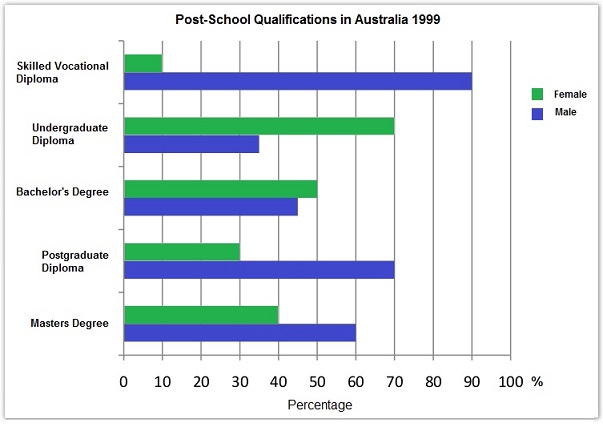
The chart below shows the different levels of post-school qualifications in Australia and the proportion of men and women who held them in 1999.
Sample Response
The illustration compares the post-school qualifications of Australian male and female in 1999. As is observed, more female's highest educational qualification was undergraduate diploma and bachelor degree while male outnumbered female in higher qualification levels and skilled education.
According to the chart, almost 90% of males had a skilled vocational diploma, while only approximately 10% of females had the same qualifications. Nearly 70% of women's highest qualification was an undergraduate diploma, and this ratio is more than twice than that of males. In terms of males and females whose highest education was a bachelor degree, females were slightly ahead of male with a ratio of 50%. But if we consider the females and males who had obtained post-graduation degrees, males were well ahead of females. 70% of post-graduate diplomas were completed by males and 60% master's degree was completed by females. On the contrary, only 30% of women finished a post-graduate diploma and four out of ten master's degree holders were females.
IELTS Writing Correction
- 1. Use plural nouns Original: Australian male and female Suggested revision: Australian males and females Why it matters: The report refers to groups of men and women, so both nouns must be plural.
- 2. Fix number agreement Original: more female's highest educational qualification was Suggested revision: more females' highest educational qualifications were Why it matters: The plural subject requires a plural possessive noun, noun, and verb.
- 3. Pluralise qualifications Original: undergraduate diploma and bachelor degree Suggested revision: undergraduate diplomas and bachelor's degrees Why it matters: Both qualification categories refer to multiple holders and need standard noun forms.
- 4. Use plural groups Original: while male outnumbered female Suggested revision: while males outnumbered females Why it matters: Comparing the two groups requires plural nouns.
- 5. Name categories precisely Original: higher qualification levels Suggested revision: postgraduate qualifications Why it matters: The relevant male-dominated categories are the postgraduate diploma and master's degree.
- 6. Use chart term Original: skilled education Suggested revision: skilled vocational qualifications Why it matters: This phrase accurately names the skilled vocational diploma category.
- 7. Use exact value Original: almost 90% Suggested revision: 90% Why it matters: The chart shows the male share of skilled vocational diploma holders at 90%.
- 8. Use exact value Original: approximately 10% Suggested revision: 10% Why it matters: The chart shows the corresponding female share at 10%.
- 9. Use singular category Original: qualifications Suggested revision: qualification Why it matters: The reference is to one qualification category, the skilled vocational diploma.
- 10. Use exact value Original: Nearly 70% Suggested revision: 70% Why it matters: The undergraduate diploma bar for women is exactly 70%.
- 11. Describe proportions correctly Original: women's highest qualification was an undergraduate diploma Suggested revision: undergraduate diploma holders were women Why it matters: The chart shows the gender composition within each qualification, not the share of women whose highest qualification was that diploma.
- 12. Use proportion term Original: ratio Suggested revision: proportion Why it matters: Proportion is the more precise term for a percentage share in the chart.
Suggested Rewrites
- Australian male and female Australian males and females
- more female's highest educational qualification was more females' highest educational qualifications were
- undergraduate diploma and bachelor degree undergraduate diplomas and bachelor's degrees
- while male outnumbered female while males outnumbered females
- higher qualification levels postgraduate qualifications
- skilled education skilled vocational qualifications
Why this response received Band 6.5
The report has a clear overview and covers all five qualification types with generally effective comparisons. Its main weakness is data accuracy: the master’s-degree figure is first attributed to women although the chart shows 60% men, creating a contradiction with the following sentence; the undergraduate ratio is also overstated. Verify each gender-value pairing before writing, then express the figures as proportions of qualification holders.
IELTS Writing Criteria Scores
Task Achievement
The response presents a relevant overview and covers every qualification, but it reverses one master’s-degree figure and slightly overstates the undergraduate comparison.
Check each bar’s gender and value carefully and describe the percentages as proportions of holders rather than qualifications completed.
Coherence and Cohesion
The overview and detail paragraph create clear progression, although some contrast markers are mechanical or logically misplaced.
Group related comparisons more deliberately and use contrast linkers only where the preceding and following statements genuinely oppose each other.
Lexical Resource
There is sufficient chart vocabulary and some effective comparative language, but awkward collocations and inaccurate forms reduce precision.
Use standard phrases such as ‘the proportion of holders’ and proofread noun forms, possessives, and qualification labels.
Grammatical Range and Accuracy
A mix of simple and complex structures communicates the main comparisons, but recurring agreement, article, plural, and comparative errors remain noticeable.
Prioritise agreement between percentage subjects and verbs, and revise comparative structures such as ‘twice as high as’.
Write this task while it is fresh
Try the same task now. It helps you remember the feedback and write better next time.
IELTS Academic Writing Task 1
The chart below shows the different levels of post-school qualifications in Australia and the proportion of men and women who held them in 1999.
Your response
Write the task yourself, then compare your choices with the annotated response.