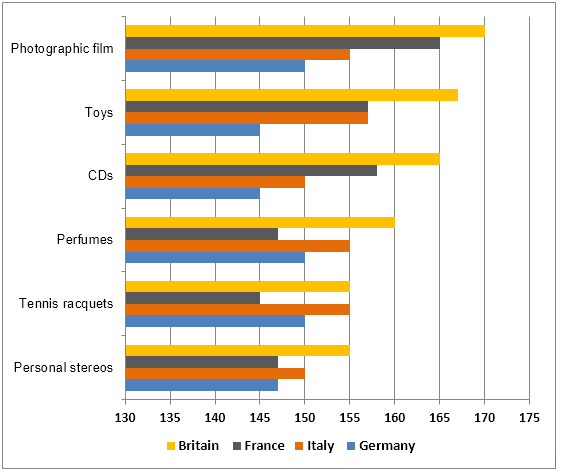
The chart below shows the amount spent on six consumer goods in four European countries.
Sample Response
The bar graph compares the spending on six consumer products by citizens in four European countries. Overall, British spent more on these products than the citizens in other three countries did and their highest amount went on purchasing photographic films, toys and CDs.
As is observed, English spent 155 thousand pound sterling for purchasing personal stereos and the same amount for tennis racquets. French and German paid around 147 thousand for stereos and Italians a few thousand more. Italians spent the same amount as English did for tennis bats, which was more than the amount spent by Germans and French.
British disbursed the highest amount for obtaining photographic films and toys and these amounts stood at 170 and 167 thousand pounds. French people spent 5-6 thousand less on these two items but their spending was higher than the amount paid by Italians and Germans for these two items.
Spending on CDs by English was slightly lower than that of toys, 165 thousand and Germans spent the least amount on this product. Finally, British people spent 160 thousand for buying perfumes and it was 155, 150 and around 146 thousand by Italian, German and French respectively.
IELTS Writing Correction
- 1. Use a noun for people Original: Overall, British Suggested revision: Overall, British consumers Why it matters: “British” needs a following noun when referring to people collectively in this structure.
- 2. Add definite article Original: the citizens in other three countries Suggested revision: citizens of the other three countries Why it matters: The specified remaining countries require “the other three,” and “of” is the natural preposition.
- 3. Name consumers accurately Original: English spent Suggested revision: British consumers spent Why it matters: “English” does not represent all consumers in Britain shown by the chart.
- 4. Format the amount Original: pound Suggested revision: pounds Why it matters: The currency unit must be plural after 155 thousand.
- 5. Use spending preposition Original: for purchasing personal stereos Suggested revision: on personal stereos Why it matters: Money is conventionally described as being spent “on” a product.
- 6. Identify the consumers Original: French and German paid Suggested revision: French and German consumers spent Why it matters: The nationality adjectives need a noun, and “spent” fits expenditure data more precisely.
- 7. Supply currency and preposition Original: around 147 thousand for stereos Suggested revision: around 147 thousand pounds on stereos Why it matters: The amount needs its currency unit and the correct spending preposition.
- 8. Supply the missing verb Original: Italians a few thousand more Suggested revision: Italian consumers spent a few thousand pounds more Why it matters: The coordinated clause needs its own verb and an explicit unit.
- 9. Use Britain consistently Original: as English did Suggested revision: as British consumers did Why it matters: The chart category is Britain, so the nationality reference should remain consistent.
- 10. Use the chart label Original: bats Suggested revision: racquets Why it matters: The product shown in the chart is tennis racquets, not tennis bats.
- 11. Use parallel nationality nouns Original: by Germans and French Suggested revision: by German and French consumers Why it matters: The two nationality references need a consistent grammatical form.
- 12. Use natural reporting verb Original: British disbursed Suggested revision: British consumers spent Why it matters: “Spent” is the natural neutral verb for reporting consumer expenditure.
Suggested Rewrites
- Overall, British Overall, British consumers
- the citizens in other three countries citizens of the other three countries
- English spent British consumers spent
- pound pounds
- for purchasing personal stereos on personal stereos
- French and German paid French and German consumers spent
Why this response received Band 7.0
The response gives a clear overview and covers all six products with a well-organised range of comparisons and figures. Its main weakness is precision: the gap for photographic film is understated, French toy spending is incorrectly placed above Italy's, and recurring demonym and sentence-form errors make some descriptions awkward; the priority is to verify each plotted value and express country comparisons in consistently accurate grammatical forms.
IELTS Writing Criteria Scores
Task Achievement
The overview is clear and all product categories are addressed with relevant data, although a few comparisons and numerical gaps are inaccurate.
Cross-check each bar before writing, especially the French-Italian toy comparison and the British-French gap for photographic film.
Coherence and Cohesion
The response follows a logical product-based progression, with clear paragraphing and cohesive movement from the overview through detailed comparisons.
Tighten sentence boundaries within the detail paragraphs so each comparison is presented as one clean, self-contained unit.
Lexical Resource
There is a good range of spending and comparison vocabulary, but some overformal choices and inaccurate labels, such as 'tennis bats', reduce precision.
Use natural task-specific terms consistently, including 'Britons', 'spent', 'photographic film', and 'tennis racquets'.
Grammatical Range and Accuracy
Varied sentence structures convey the comparisons clearly, but missing articles, faulty nationality forms, ellipsis, and occasional run-on coordination recur.
Proofread nationality nouns and complete each clause with an explicit subject and verb, particularly when listing several countries and figures.
Write this task while it is fresh
Try the same task now. It helps you remember the feedback and write better next time.
IELTS Academic Writing Task 1
The chart below shows the amount spent on six consumer goods in four European countries.
Your response
Write the task yourself, then compare your choices with the annotated response.