The chart below shows the total number of minutes (in billions) of telephone calls in the UK, divided into three categories, from 1995-2002. UK telephone calls, by category, 1995-2002
Same question Compare 2 different answers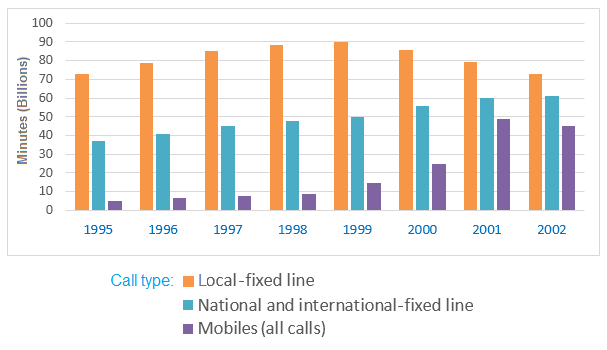
Sample Response
A glance at the bar graph reveals how many minutes (in billions) of telephone conversations were made in Britain in eight years, 1995 to 2002. Overall, the local fixed-line calls were the most popular type from 1995 to 2002 but the increasing use of cell phone in later years was noticeable. In 1995, the local call duration was 70 billion minutes and then it steadily rose to approximately 90 billion after four years. However, the local calls span rapidly slipped to somewhere in the vicinity of 70 and 80 billion. In a stark contrast, the national and international - fixed lines and mobiles (all calls) features showed upward trends. It is evident that the national and international fixed line calls climbed gradually from just under 40 to 60 billion in 2002. The mobiles calls, however, grew steadily in the first five years and after that witnessed a quick rise to more than 40 billion minutes. It is interesting to note that through eight years period, the local fixed-line calls remained the highest among three call types in the United Kingdom.
IELTS Writing Correction
- 1. Fix time expression Original: in eight years, 1995 to 2002 Suggested revision: over eight years, from 1995 to 2002 Why it matters: “Over” and “from” correctly express the duration and its endpoints.
- 2. Describe measured quantity Original: most popular type Suggested revision: category with the highest call duration Why it matters: The chart measures total minutes rather than users’ popularity preferences.
- 3. Use plural noun Original: use of cell phone Suggested revision: use of mobile phones Why it matters: The general category requires a plural count noun, and “mobile phones” matches the chart terminology.
- 4. Hyphenate compound modifier Original: fixed line calls Suggested revision: fixed-line calls Why it matters: “Fixed-line” is a compound modifier before “calls” and should be hyphenated.
- 5. Fix category noun Original: The mobiles calls Suggested revision: Mobile calls Why it matters: “Mobile” functions as the modifier here, so the plural “mobiles” and article are incorrect.
- 6. Fix duration phrase Original: through eight years period Suggested revision: throughout the eight-year period Why it matters: The phrase needs “throughout,” an article, and a hyphenated singular time modifier.
- 7. Add definite article Original: among three call types Suggested revision: among the three call types Why it matters: The three previously specified categories require the definite article.
- 8. Use concise introduction Original: A glance at the bar graph reveals Suggested revision: The bar chart shows Why it matters: The shorter reporting phrase is more direct and appropriately formal.
- 9. Match chart terminology Original: conversations Suggested revision: calls Why it matters: “Telephone calls” is the precise category measured by the chart.
- 10. Match task wording Original: Britain Suggested revision: the UK Why it matters: Using the task’s geographical label keeps the report consistent with the chart.
- 11. Add clause comma Original: 2002 but Suggested revision: 2002, but Why it matters: A comma should precede “but” when it joins two independent clauses.
- 12. Name category precisely Original: the local call duration Suggested revision: the duration of local fixed-line calls Why it matters: The revision identifies the chart category explicitly and uses a more natural noun phrase.
Suggested Rewrites
- in eight years, 1995 to 2002 over eight years, from 1995 to 2002
- most popular type category with the highest call duration
- use of cell phone use of mobile phones
- fixed line calls fixed-line calls
- The mobiles calls Mobile calls
- through eight years period throughout the eight-year period
Why this response received Band 7.0
The response identifies the dominant call type and the contrasting trends clearly, supporting them with well-chosen start, peak, and end figures. Its main limitation is presentation: all information is compressed into one paragraph, and several awkward phrases reduce precision despite clear meaning. Prioritise separating the overview from grouped details and polishing noun phrases and comparisons so the accurate analysis reads more fluently.
IELTS Writing Criteria Scores
Task Achievement
The response provides a clear overview and accurately selects the principal trends and figures for all three call categories.
Refine the description of the post-1999 local-call decline by stating its endpoint directly rather than giving the vague range of 70 to 80 billion.
Coherence and Cohesion
The sequence from overview to the three trends is logical and easy to follow, but the lack of paragraphing prevents effective grouping of the information.
Place the overview in its own paragraph and divide the detailed trends into two logically grouped body paragraphs.
Lexical Resource
The response uses a reasonably varied range of trend vocabulary, though phrases such as "local calls span," "features showed," and "mobiles calls" are imprecise.
Use natural noun phrases such as "the duration of local calls," "both categories rose," and "mobile calls" consistently.
Grammatical Range and Accuracy
The report contains a useful mix of structures with generally clear control, but article, plural, and noun-phrase errors appear in several sentences.
Edit plural forms and articles in phrases such as "mobile calls," "an eight-year period," and "the highest of the three types."
Write this task while it is fresh
Try the same task now. It helps you remember the feedback and write better next time.
IELTS Academic Writing Task 1
The chart below shows the total number of minutes (in billions) of telephone calls in the UK, divided into three categories, from 1995-2002. UK telephone calls, by category, 1995-2002
Your response
Write the task yourself, then compare your choices with the annotated response.