Bài Writing chính thức trong Cambridge IELTS 18–21
Đối chiếu toàn bộ 64 bài Writing chính thức hiện có trong Cambridge IELTS 18–21 cho cả Academic và General Training: 50 bài thí sinh có điểm cùng 14 bài mẫu do giám khảo viết, luôn đi kèm đề bài và nhận xét đầy đủ.
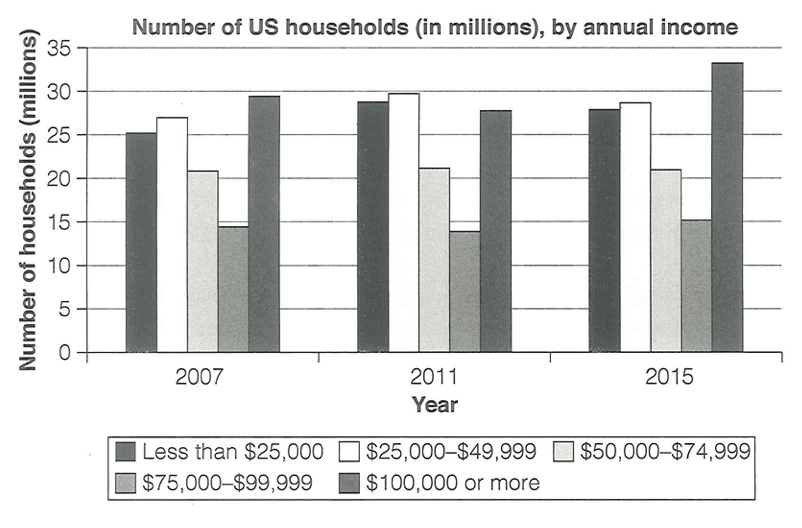
The chart below shows the number of households in the US by their annual income in 2007, 2011 and 2015.
Summarise the information by selecting and reporting the main features, and make comparisons where relevant.
Write at least 150 words.
Bài viết đầy đủ của thí sinh
The graph illustrats the data of different levels of annual wage of families in the united states in 2007, 2011 and 2015.
As far as the number of families whose annual income was less than $25,000, it began with around >5 million in 2007, then increased to approximately 27 million in 2011, but decreased by 2 million 4 years later. Similarly, those of families that earned $25,000 to $49,999 were about 25 million in 2007, after that it rose to nearly 30 million in 2011. Finally it decreased to around 27 million in 2015.
By contrast, the groups of families which have high income, including $75,000 to $99.999 and $100,000 or more, experienced a drop in 2011, but their data went up in 2015.
Interesting things could be seen in the group of middle income, the data remain the same in 2007, 2011 and 2015.
Nhận xét đầy đủ của giám khảo
This response does present most of the data within the bar chart and the key features required. To improve the response, an overview of the information should be included, for example: Across the 8 years, households with incomes below $50,000 rose, then fell back slightly, households with incomes of over $75,000 fell slightly then increased and those with the mid-level incomes remained the same. The information is arranged coherently, starting with the details for the lower-income households, then the higher, then the mid-section. There are some effective cohesive devices [As far as Similarly By contrast]. The vocabulary is suitable for the task, but there is an error [>5 million / 25 million] which is not helpful when reporting the details. There is a mix of simple and complex structures, with sentences that contain multiple clauses. There are some examples of missing capitalisation [united states / United States] with some errors [remain I remained]. To improve the response, it is important to re-read to check for small errors with vocabulary and to include an overview or summary of the salient information.
Some university students want to learn about other subjects in addition to their main subjects. Others believe it is more important to give all their time and attention to studying for a qualification.
Discuss both these views and give your own opinion.
Bài mẫu chính thức do giám khảo viết
Students attend university to improve their prospects and find suitable employment after graduation. For this reason, some feel that they should focus all their energy on their main subjects to gain a relevant qualification. Others want a more well-rounded education, so they try to learn about additional subjects.
It is perfectly reasonable for students to enter university with a strong sense of curiosity and a desire to learn as much as possible. Unfortunately, we tend to put subjects into artificial boxes, suggesting that business, art and science are not connected. If students become too focused on a single area, it may stifle their initial curiosity, limiting their potential. They could also graduate with a very narrow skill set that doesn't translate well to the current job market, which often favours those who have taken a multidisciplinary approach to their studies.
Despite this, caution is certainly needed. The more we learn about a subject, the more complex it becomes. Gaining an in-depth, specialist knowledge of a subject requires a certain level of focus and dedication over a long period. If we try to learn about too many things at once, our knowledge may lack the depth required to obtain a qualification. If they are not careful, young people could begin to lose interest in their main subjects, which would be detrimental to their studies.
While learning about other subjects is not necessarily a bad thing, I believe university students should ensure that their main subjects remain the priority so that they do not lose sight of their objective: gaining a qualification. Then they can calculate how much time, energy and headspace they have left for learning about other topics.
Nhận xét của giám khảo về bài mẫu
This response addresses both parts of the task and presents a clear opinion at the end. The second paragraph explains how the current university system is set up to [put subjects into artificial boxes] and how this narrow focus can disadvantage students. The third paragraph presents the benefits of [Gaining an in-depth, specialist knowledge] and the dangers of trying to include too much. Both sides of the question are addressed in well-developed paragraphs.
To improve the response, it would be helpful to set out the opinion at the start, for added continuity of the position.
Vocabulary is natural and sophisticated [stifle their initial curiosity | Gaining an in-depth, specialist knowledge | detrimental to their studies] without errors.
Grammatical structures are wide-ranging, with a range of tenses and conditional [if] and modal [may | could | would | can] structures embedded in complex, flexible sentences.
This is a high-level response which fully addresses the task.
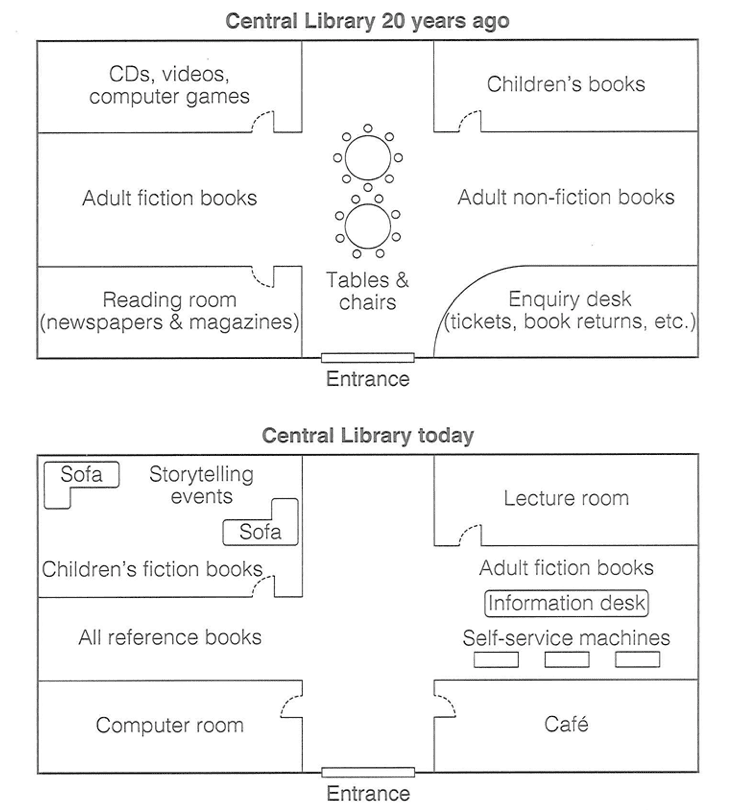
The diagram below shows the floor plan of a public library 20 years ago and how it looks now.
Summarise the information by selecting and reporting the main features, and make comparisons where relevant.
Bài mẫu chính thức do giám khảo viết
The diagrams show Central Library before and after changes were made to its layout.
Clearly, the library has been updated to include dedicated spaces for events and now has an open space in the centre.
Twenty years ago, to the left of the entrance there was a reading room with newspapers and magazines and to the right there was an enquiry desk. Now there’s a computer room on the left and a café where the information desk once was. Adult fiction has moved to the right-hand side of the room and all reference books are now on the left. There is a smaller information desk with self-service machines in what once was the adult non-fiction section.
There was a room at the back left-hand corner that had computer games, CDs and videos that has since been enlarged and houses children’s fiction. It has a space with two sofas where storytelling events are held. There is a lecture room in the back right-hand corner where children’s books used to be.
Nhận xét của giám khảo về bài mẫu
This response covers the main changes that have occurred over the 20-year period. An overview is presented in the second paragraph which is quite general: it refers to the [dedicated spaces for events] but this could be improved by giving a summary of the key changes (dedicated spaces for events, self-service facilities and a café).
Ideas are arranged logically: the changes to the front of the library are presented in the third paragraph and the changes to the back section in the final paragraph. This shows a logical approach to reporting the changes and there is some good cohesion [once was | now on the left | has since been].
There is a good range of vocabulary. In this kind of task, vocabulary from the floor plan needs to be used to report the changes, but the use of different words shows some flexibility and precision [been updated | dedicated spaces | houses].
In terms of grammar, there are error-free sentences and some variation in structures used when describing changes [has been updated | what once was | has since been enlarged].
The response could be improved by extending the overview to include more of a summary of the main changes but overall, this response captures the main changes in a logical way.
In many countries around the world, rural people are moving to cities, so the population in the countryside is decreasing.
Do you think this is a positive or a negative development?
Bài mẫu chính thức do giám khảo viết
Statistics show that the world’s population is increasing rapidly. It is expected that most of us will be living in cities within the next few decades. The question of whether urbanisation is a positive or negative development remains controversial.
A rapid influx of people moving from rural to urban areas is bound to cause problems. Firstly, pressure on resources such as housing and transportation intensifies. It is becoming difficult for many people to afford adequate housing in cities. A by-product of this is the creation of slums causing low-income families to group together in neglected parts of the city. These people often become trapped in a cycle of poverty that is difficult to escape.
As mentioned above, the growth of urban areas can also lead to severe traffic congestion because more and more vehicles travel into the city from the suburbs. This has many knock-on effects, such as problems with air quality. It also leads many city dwellers to experience mental health issues because travelling across large cities is tiring and stressful.
All of this being said, I don't believe that urbanisation is a wholly negative development. There are advantages to living in large cities that are well managed. For example, there are more schools which means more education opportunities. Access to higher-quality health care is often better in cities. Some cities have also introduced ride-sharing, e-bikes and park and ride services that reduce environmental problems.
My opinion is that many of the problems associated with urbanisation are avoidable but dealing with increasing populations in cities is a formidable challenge. How governments, businesses and society respond to this challenge will dramatically affect the future of our world.
Nhận xét của giám khảo về bài mẫu
This response addresses both sides of the question and presents a position, that the movement to cities is not a [wholly negative development]. The second and third paragraphs lay out the problems that can be caused by a [rapid influx] of people to urban areas [housing | transportation | traffic congestion] and the fourth paragraph presents some of the advantages [education opportunities | higher-quality health care | environmental transport initiatives].
However, the part of the question about ‘the population in the countryside ... decreasing’ is not covered. The candidate would need to include it to provide a full answer to this question.
Information and ideas are logically organised and there is a clear progression, starting with the challenges and ending with a range of advantages.
Vocabulary is used with a natural and sophisticated control [bound to | trapped in a cycle of poverty | severe traffic congestion | knock-on effects], although rare errors remain [education opportunities / educational opportunities]. Grammar is flexible and accurate, with a wide range of structures included. There are some shorter sentences which could be extended and more multi-clause examples could be included to add complexity.
To improve this response, consideration should be given to the impact of the shrinking population in the countryside.
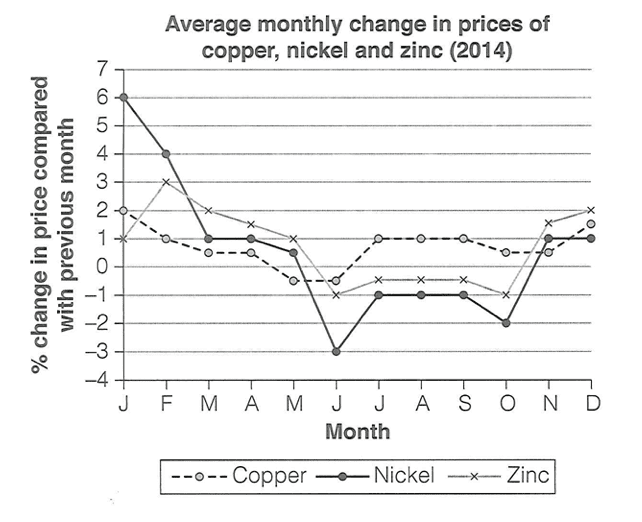
The graph below shows the average monthly change in the prices of three metals during 2014.
Summarise the information by selecting and reporting the main features, and make comparisons where relevant.
Bài mẫu chính thức do giám khảo viết
From the line graph, we can see the average monthly rise or fall in how much copper, nickel and zinc cost throughout 2014.
Overall, nickel started with the highest percentage change of the three but ended with the lowest. Zinc started with the smallest change and ended with the highest, and copper prices fluctuated. Prices for all three metals dipped in June.
In January the price of nickel was up six per cent, but this dropped to negative three percent in June, ending the year with a one percent increase in both November and December. Copper began the year with an increase of two percent and by May, the price was dropping (by slightly less than one per cent). It rose again, increasing by a percentage point in July, August and September. Zinc saw its most dramatic increase in February, with three per cent and the price fell in June (a one percent decrease). The change was negative until October/November when it began to rise.
Nhận xét của giám khảo về bài mẫu
This response reports the main data for each of the three metals. There is an introduction in the first paragraph and an overview in the second, followed by the presentation of the main trends of all three categories in the third. Some details are missing (copper after September and no percentage changes for any metal from July to September).
The candidate identifies the ‘dip’ for all three in June, but to score more highly, they could also have mentioned that overall, percentage changes fell at the beginning of the year, remained static from July to September and rose after October to the end of the year.
Information is arranged coherently; each metal is taken in turn for data reporting. There is good use of cohesive devices [Overall | but | with | when], but there could be more.
Vocabulary is adequate with some attempts to use less common items [fluctuated | dramatic increase] and attempts to use synonyms [ended with the lowest | dipped | dropped].
There is a lack of complex structures, as most sentences are simple or compound. However, there is some variety in structures, including comparatives [highest | smallest | most dramatic] and continuous tenses [was dropping].
To improve the response, the candidate could extend the overview to reflect some common trends and should include some of the missing details.
In many countries, people are now living longer than ever before. Some people say an ageing population creates problems for governments. Other people think there are benefits if society has more elderly people.
To what extent do the advantages of having an ageing population outweigh the disadvantages?
Bài mẫu chính thức do giám khảo viết
The population in most parts of the world is ageing; people are living longer and there are fewer younger people in many places as birth rates fall. This phenomenon has pros and cons, but this essay will contend that, on balance, the advantages of having an older population outweigh the negatives.
The first issue that occurs to many people when considering the ageing population is the expense. If people live longer, they may have more than 30 years of retirement and may need to be supported financially by the government or their families. If they experience age-related illness, this impacts the health system and takes up resources needed by other people in society. What’s more, when older people are financially independent, it might be hard for younger people if they have to compete to get a foot in the door of the housing market or gain employment.
That being said, older people have a lot to contribute in terms of wisdom, experience and skills. Many people are active and productive for longer than their counterparts were 50 years ago and are an asset to the economy and society well into their old age. They are able to work for longer and after retirement they contribute in many ways too, such as by doing charitable work, spending money as consumers and supporting their families. Grandparents often care for their young grandchildren, making it easier for both parents to work.
While it is true that an ageing population poses challenges for governments, it is clear that these are outweighed by the significant benefits that elderly people bring to society.
Nhận xét của giám khảo về bài mẫu
This is a good response to the task. Both sides of the argument are presented, with the ideas extended for both. The candidate makes their position clear from the beginning, that there are more advantages than disadvantages.
The second paragraph addresses the expense of looking after the elderly, the health system and the cost for governments. It also captures the challenge that older people take up houses and jobs so younger people cannot progress.
The third paragraph presents the advantages of the [wisdom, experience and skills] older people can bring: that they are more active and remain productive for longer, not only working, but also [doing charitable work, spending money as consumers, supporting their families and even grandchildren for the working parents].
This means that the conclusion is relevant and justified.
Ideas are organised and cohesion has good progression.
Vocabulary is skilfully used, with some high-level terms [phenomenon | age-related illness | impacts the health system] and some sophisticated examples [get a foot in the door | counterparts].
There are a range of complex grammatical structures, including several conditional structures [if]. The conditionals are used to emphasise the challenges presented and are without errors.
This is a high-level, fully developed response with ideas that are well supported, extended and engaging.
Your English-speaking friend has asked for your help with a college project he/she is doing about celebrating New Year in different countries.
Write a letter to your friend. In your letter:
Say how important New Year is to people in your country
Describe how New Year is celebrated in your country
Explain what you like about New Year celebrations in your country
Bài mẫu chính thức do giám khảo viết
Dear Mia
It’s great to hear from you; your project sounds really interesting. I’d be happy to tell you about Tet in Vietnam.
Tet is short for Tết Nguyên Đán and it’s our New Year according to the lunar calendar. It’s the first day of spring and it’s usually in January or February. It’s really important to us as it’s a chance for the family to come together and we visit the graves of our ancestors. It’s probably the biggest festival in Vietnam and it’s a public holiday. We say if good things happen on the first day of the new year, the whole year will be full of blessings.
I always loved it as a child because I would get a red envelope with money inside it from the older members of the family. Now I like visiting friends and the extended family on the week of Tet and enjoying the lovely candied fruits that we have on this occasion.
I hope that helps. Do ask if there’s anything else you’d like to know.
All the best
Nhận xét của giám khảo về bài mẫu
This is a full response to the task. The candidate addresses the first two bullet points in the second paragraph, then covers the last bullet in the third, but could add more about how New Year is celebrated. They mention [the biggest festival ... public holiday] but give no details about how it is celebrated.
However, the enthusiastic tone is just right for a letter to a friend, and progression in the response is clear. There are some effective linking expressions [according to | because | Now], although in the second paragraph, most sentences start with [It’s], so a wider range would improve the response.
The range of vocabulary includes some less common items and some good collocation [come together | good things happen], but it could be wider. Similarly, there is a mix of grammatical structures, including conditionals [if], but generally, the range is limited with simple structures and short, compound sentences. Overall, this is an appropriate and engaging response. To improve it, the range of cohesive devices and grammatical structures could be widened.
Some people say that it is better to work for a large company than a small one. Do you agree or disagree?
Bài mẫu chính thức do giám khảo viết
Job seekers often question whether it is better to work for a large or a small company. I would personally prefer to work for a larger company, but I’d like to consider the advantages and disadvantages of both.
In general, larger companies can support their employees more effectively because they have access to more resources. These could include higher salaries, end-of-year bonuses, and other perks such as an excellent food service and even sports facilities. Large companies may also contribute more to your professional development, offering regular conferences and training courses.
The size of a large company is also an indication of their success, meaning that it can offer greater stability. There is also a better chance for promotion and career development in companies with many departments and a larger management structure. Of course, advancement may not come easily because it is hard to stand out when many employees are vying for the same role.
In small companies, you may feel less like a number and that your efforts actually make a difference. You will also need to wear different hats, which helps you develop a skill set that might not be possible in a larger company. The downside is a higher chance of strained relationships because working in close proximity with the same small group of people every day can be challenging. Small companies can also be unstable. If they lose a large account or consumer tastes change, your position could suddenly become precarious.
Based on the above, I’d say that the kind of company you work for depends on personal preference, but your future career prospects may be better in a large company.
Nhận xét của giám khảo về bài mẫu
This response covers both aspects of the task, including the pros and cons of each type of workplace, with some useful detail and good supporting ideas. Ideas are logically organised and cohesion is very well managed throughout.
There are a range of linkers [Of course | Based on the above] and other cohesive devices [both | your | their | which], which means it is easy to read. Paragraphing is generally good, with the introduction and conclusion sitting separately. However, the second and third paragraphs would be better combined, as they both address ‘large’ companies.
Vocabulary is strong and there are some natural and sophisticated examples [vying for | wear different hats | strained relationships]. Grammar is flexible and accurate, with a range of structures including modals [can | may | could] and conditionals [If] as part of complex, multi-clause sentences. Errors are rare.
This is a good example of a high-level response.
You are soon going to spend three months doing work experience in an organisation.
Write a letter to the manager of the organisation where you are going to do work experience. In your letter:
Thank the manager for the opportunity to do work experience
Explain what you hope to learn from the work experience
Ask some questions about the work experience you are going to do
Bài mẫu chính thức do giám khảo viết
Dear Sir or Madam,
I am excited to be starting work experience at the REN Broadcasting Corporation on 10 June and I would like to thank you very much for this opportunity. I am grateful to have the chance to gain some insight into the industry I wish to work in one day.
As I mentioned in my interview, I am especially interested in community television and would love to build on my skills in sound engineering. Besides this, I am hoping to develop my soft skills in areas such as teamwork, problem solving and effective communication.
I was wondering if it has been decided which team I will be working with and whether I will have a mentor assigned to me. I would like to prepare ahead of time if possible by doing some research. I also wanted to clarify whether I will be at the studio in Newtown or the headquarters in the city centre.
I am looking forward to hearing from you.
Kind regards
Nhận xét của giám khảo về bài mẫu
This is a strong response to the task; it addresses all three bullet points and uses a suitable tone to communicate with the manager of the organisation. The response is presented in the correct letter format, with an appropriate ending, and there is clear progression throughout the letter.
The range of vocabulary is wide and precise [gain some insight into | develop my soft skills | mentor assigned], without errors. The writing contains a wide range of structures, including conditionals [if] and passives [it has been decided], with accurate multi-clause sentences.
This is a good example of a higher-level response.
When we meet someone for the first time, we generally decide very quickly what kind of person we think they are and if we like them or not. Is this a good thing or a bad thing?
Bài mẫu chính thức do giám khảo viết
Some people say that we form an opinion about a person within thirty seconds of meeting them. A person’s clothing, facial expression, and even the way they shake hands can have a profound effect on our judgement. But is this natural human tendency good or bad?
There is something unfair about our inclination to judge people too quickly. Many people have had unfortunate life experiences that can affect their confidence when meeting new people. Shyness may make them appear aloof and cold, but this initially icy persona melts away when we allow them a bit of time to warm up. Others do not have the means to dress in a way that leaves an impression. Inevitably, if we write people off too quickly, we could miss out on potential friendships, business opportunities and even romantic relationships.
There is another side to this that is also worth considering. We are all aware of the effect first impressions can have. There is even a saying: you don’t get a second chance to make a first impression. Awareness of this reality should motivate us to always treat people in a friendly, respectful manner. If we strive to make a good impression on the people we meet, it increases our overall happiness and sense of well-being.
On balance, there is no doubt that judging people too quickly can have negative consequences. But knowing the power of first impressions can keep us on our toes, motivating us to question how we come across to others. Aside from this, the ability to read people quickly could also prevent us from being easily taken in by somebody with ulterior motives.
Nhận xét của giám khảo về bài mẫu
This response presents both sides of the argument and the ending concludes that forming impressions early can be either positive or negative. The second paragraph presents the downsides of judging too rapidly: the impact of low confidence, being shy or not having smart clothes. It also notes that people could miss out on friendships, opportunities and romance if they judge too harshly.
The third paragraph is not entirely relevant. The question asks about the evaluation people make about the ‘kind of person’ and whether ‘we like them’ but this paragraph mainly gives advice on how to behave when meeting new people. It should be more aligned to the question and present the advantages of forming early impressions.
There is a very wide range of vocabulary with some higher-level items [affect their confidence | aloof | icy persona | strive to make | come across]. Overall, the response includes a variety of accurate complex grammatical structures, with many long sentences containing a number of clauses.
Vocabulary and grammatical structures are very strong, accurate and flexible throughout. To improve the response, the third paragraph could present more clearly the advantages of quick decisions about the people we meet.