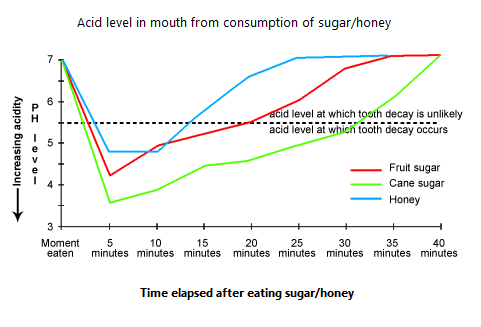
Eating sweet foods produces acid in the mouth, which can cause tooth decay. (High acid levels are measured by low pH values) Describe the information below and discuss the implications for dental health.
Sample Response
The bar graph illustrates the acid level of mouth after consumption of three different nutrients such as fruit sugar, cane sugar and honey over the period of forty minutes. According to the bar graph, it is obvious that cane sugar is the most acidic nutrient.
After the consumption of cane sugar, acidity level of month increased sharply in five minutes and reached 3.5 pH level. From now onwards acidity level of mouth decreases steadily and reached the normal level after thirty-five minutes. However, teeth remained at the dangerous level more than 25 minutes.
Another acidic nutrient is fruit sugar. After the consumption, the pH level of mouth decreased hurriedly and reached 4.25 in five minutes. After that, the level of acidity of month reached a normal level in 15 minutes. Therefore, teeth remained at the dangerous level for 15 minutes. The last and the least acidic nutrient is honey, after the consumption of honey acidity level of mouth increased dramatically in five minutes and reached 5 pH level and then, plateau for 5 minutes and from now onward decreased moderately. However, teeth remained in an acidic environment for 10 minutes.
To conclude, the more hazardous nutrient for teeth is cane sugar because teeth remained in an acidic environment for more than 25 minutes.
IELTS Writing Correction
- 1. Identify line graph Original: bar Suggested revision: line Why it matters: The visual uses three continuous lines rather than bars.
- 2. Name pH measure Original: acid level of mouth Suggested revision: pH level in the mouth Why it matters: The graph directly plots pH, with lower values representing greater acidity.
- 3. Add article Original: after consumption of Suggested revision: after the consumption of Why it matters: Consumption requires the definite article in this construction.
- 4. Introduce complete list Original: nutrients such as Suggested revision: sweeteners: Why it matters: These three substances form the complete set shown rather than examples of a broader list.
- 5. Add indefinite article Original: the Suggested revision: a Why it matters: A is required when introducing the forty-minute period.
- 6. Use objective phrasing Original: obvious Suggested revision: clear Why it matters: Clear is more neutral and conventional in an analytical report.
- 7. Describe lowest pH Original: most acidic nutrient Suggested revision: sweetener producing the greatest acidity Why it matters: This wording connects the claim to cane sugar's lowest plotted pH.
- 8. Correct mouth phrase Original: acidity level of month Suggested revision: the acidity level in the mouth Why it matters: Month is a spelling error, and the phrase needs an article and preposition.
- 9. Clarify time span Original: increased sharply in five minutes Suggested revision: rose sharply within five minutes Why it matters: Within clearly marks the interval after consumption.
- 10. State pH correctly Original: 3.5 pH level Suggested revision: a pH of 3.5 Why it matters: Numerical pH values are expressed with the structure a pH of.
- 11. Use decay threshold Original: at the dangerous level more than 25 minutes Suggested revision: below the tooth-decay threshold for about 25 minutes Why it matters: The cane-sugar line remains below pH 5.5 for roughly twenty-five minutes.
- 12. Compare lowest pH Original: Another acidic nutrient is fruit sugar Suggested revision: Fruit sugar produced the next-lowest pH Why it matters: This makes the comparison with cane sugar and honey explicit.
Suggested Rewrites
- bar line
- acid level of mouth pH level in the mouth
- after consumption of after the consumption of
- nutrients such as sweeteners:
- the a
- obvious clear
Why this response received Band 6.0
The response covers all three substances, correctly recognises cane sugar as the greatest dental risk, and links time below the danger threshold to tooth decay. Its main limitation is data interpretation: fruit sugar remains below the safe threshold for roughly 20 minutes, and several recovery times are confused with a return to neutral pH. Prioritise distinguishing falling pH from rising acidity and reporting each threshold crossing accurately.
IELTS Writing Criteria Scores
Task Achievement
All three lines and the dental implication are addressed, but several duration and recovery claims are inaccurate or conceptually confused.
State the minimum pH for each substance and compare how long each line remains below pH 5.5, without calling that threshold neutral.
Coherence and Cohesion
The response is organised by substance and ends with a relevant conclusion, though linking is repetitive and the long honey sentence is poorly controlled.
Use one balanced detail paragraph for the initial drops and another for recovery times and danger durations.
Lexical Resource
Some suitable acid and trend vocabulary is used, but repeated spelling and collocation errors obscure the pH-versus-acidity distinction.
Use precise terms such as "pH fell", "acidity increased", "crossed the danger threshold", and "returned to neutral".
Grammatical Range and Accuracy
Meaning is usually recoverable, but tense shifts, missing articles, faulty verb forms, and sentence-boundary errors occur frequently.
Keep the description consistently in the past tense and break the comma-spliced honey description into controlled clauses.
Write this task while it is fresh
Try the same task now. It helps you remember the feedback and write better next time.
IELTS Academic Writing Task 1
Eating sweet foods produces acid in the mouth, which can cause tooth decay. (High acid levels are measured by low pH values) Describe the information below and discuss the implications for dental health.
Your response
Write the task yourself, then compare your choices with the annotated response.