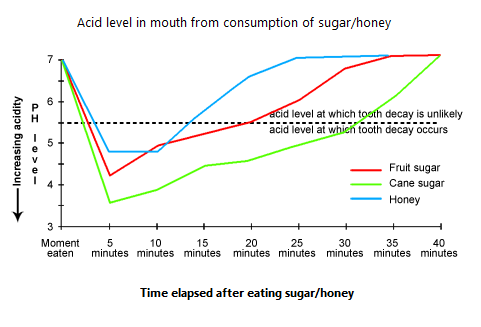
Eating sweet foods produces acid in the mouth, which can cause tooth decay. (High acid levels are measured by low pH values) Describe the information below and discuss the implications for dental health.
Sample Response
The given illustration demonstrates the acid level, which is the inverse of the pH values, different sweet foods can create in our mouth and their possible implication for our dental health. As is given in the line graph, high acid levels are measured by the low pH level in our mouth and the lower the pH level, it is more likely to decay the tooth. According to the line graph, fruit sugar, cane sugar and honey cause, different acid levels in our mouth and their impacts last for five to 30 minutes. The pH level below 5.5 is detrimental to our tooth. When we consume honey, the pH level of our mouth decreases to below 5.5 within 4 minutes and that takes around 13 minutes to come out from the danger level. In the case of fruit sugar, the pH level goes below 5.5 in 3.5 minutes and remains in danger level for about 20 minutes. Finally, when we eat cane sugar, the pH level of our mouth goes in the danger level in 2.5 minutes and remains in danger level for about 32 minutes. In short, honey is the safest sweet food for our dental health while cane sugar is most detrimental to our tooth as it is likely to cause the maximum decay in our tooth.
IELTS Writing Correction
- 1. Use precise description Original: demonstrates the acid level Suggested revision: shows the acidity levels Why it matters: The graph presents changing acidity levels rather than one fixed level.
- 2. Repair relative clause Original: which is the inverse of the pH values, different sweet foods can create Suggested revision: that different sweet foods create Why it matters: The original relative-clause structure does not connect the visual feature to the foods grammatically.
- 3. Use plural noun Original: implication Suggested revision: implications Why it matters: The discussion concerns multiple effects on dental health, so the noun should be plural.
- 4. Add indefinite article Original: The Suggested revision: A Why it matters: A singular countable noun needs an article when referring to any level below the threshold.
- 5. Use natural collocation Original: is detrimental to our tooth Suggested revision: is harmful to our teeth Why it matters: English normally describes this general health effect using the plural noun “teeth.”
- 6. Use concise trend verb Original: decreases to below Suggested revision: falls below Why it matters: “Falls below” expresses the downward crossing of a threshold more directly.
- 7. Fix pronoun reference Original: that Suggested revision: it Why it matters: The clause needs the subject pronoun “it” to refer to the recovery time.
- 8. Describe threshold accurately Original: come out from the danger level Suggested revision: rise above the danger threshold Why it matters: The pH value rises above a threshold rather than coming out from a level.
- 9. Distinguish time and duration Original: remains in danger level for about 20 minutes Suggested revision: remains in the danger zone until about 20 minutes Why it matters: The graph shows fruit sugar crossing back above 5.5 at about the 20-minute mark, not staying there for 20 full minutes.
- 10. Use accurate phrasing Original: goes in the danger level Suggested revision: enters the danger zone Why it matters: A value enters a range or zone rather than going in a level.
- 11. Correct threshold timing Original: remains in danger level for about 32 minutes Suggested revision: remains in the danger zone until about 33 minutes Why it matters: The cane-sugar line returns above pH 5.5 at approximately the 33-minute point.
- 12. Limit the comparison Original: honey is the safest sweet food Suggested revision: honey poses the lowest risk Why it matters: This wording confines the claim to the three substances compared in the graph.
Suggested Rewrites
- demonstrates the acid level shows the acidity levels
- which is the inverse of the pH values, different sweet foods can create that different sweet foods create
- implication implications
- The A
- is detrimental to our tooth is harmful to our teeth
- decreases to below falls below
Why this response received Band 6.5
The response gives a clear overall comparison and correctly identifies honey as the least harmful and cane sugar as the most harmful option, supported by generally accurate danger-period estimates. Its main limitation is incomplete selection of visual detail, particularly the different minimum pH levels and recovery times, alongside recurring awkward phrasing. Prioritise a fuller comparison of the lowest points and return-to-neutral patterns while tightening article and preposition use.
IELTS Writing Criteria Scores
Task Achievement
A clear overview and mostly accurate comparisons cover the principal dental-health implications, though the minima and full recovery patterns are omitted.
Compare the three lowest pH values and state when each line returns to the starting level.
Coherence and Cohesion
The information follows a sensible sequence from general interpretation to each sweetener, but the single dense paragraph and some repetitive linking weaken presentation.
Separate the overview from the detailed comparisons and group the three recovery patterns more explicitly.
Lexical Resource
Vocabulary is sufficiently varied for trends and consequences, although several collocations such as "decay the tooth" are imprecise.
Use natural combinations such as "cause tooth decay," "fall below the threshold," and "remain in the danger zone."
Grammatical Range and Accuracy
A range of sentence forms is attempted, and meaning remains clear despite recurring article, preposition, agreement, and clause-structure errors.
Review comparative clauses and article-preposition choices, especially in phrases describing levels and durations.
Write this task while it is fresh
Try the same task now. It helps you remember the feedback and write better next time.
IELTS Academic Writing Task 1
Eating sweet foods produces acid in the mouth, which can cause tooth decay. (High acid levels are measured by low pH values) Describe the information below and discuss the implications for dental health.
Your response
Write the task yourself, then compare your choices with the annotated response.