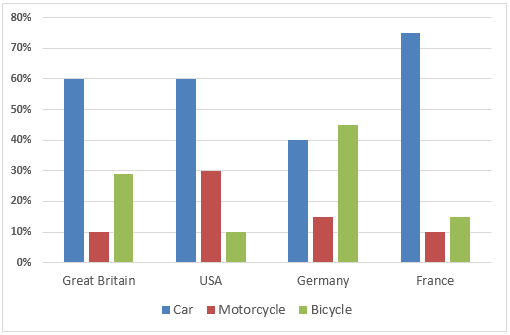
The chart below shows the type of transports young people in four countries prefer to use.
Sample Response
The column graph outlines the transportation preference among the young people in Great Britain, USA, Germany and France. As an overall trend, the young generation, except in Germany, mainly like to use the car as a mean of commuting and this ratio is the highest in France. To illustrate, six out of ten British youth favour cars to travel. Less than one-third of them use bicycles and only one of ten youth in the UK pick motorbike to commute. A similar ratio of US adolescents (precise 60%) prefers cars but their preference for motorbikes is higher than that of the UK, 30% to be exact. However, less percentage of American youngsters prefers riding bicycles, only one out of ten. Germany shows an interesting trend where almost half of the adolescents like to ride a bicycle, a trend uncommon in other countries. 40% of them choose cars as their transportation and the rest of them inclined to use motorbikes. Finally, the highest percentage of car-loving youngs are located in France, where around 2 out of 3 adolescent fancy cars over other vehicles. Around 10% of French youth use bicycle and a similar percentage ride on motorized bikes.
IELTS Writing Correction
- 1. Use a plural noun Original: transportation preference Suggested revision: transport preferences Why it matters: The chart compares multiple preferences across countries and modes.
- 2. Remove the article Original: among the young people Suggested revision: among young people Why it matters: No definite article is needed when referring to young people generally.
- 3. Add the country article Original: Great Britain, USA Suggested revision: Great Britain, the USA Why it matters: The country name “USA” normally takes the definite article.
- 4. Use direct wording Original: the young generation Suggested revision: young people Why it matters: “Young people” is more natural and matches the population represented.
- 5. Express preference naturally Original: mainly like to use the car Suggested revision: mainly prefer cars Why it matters: The direct verb “prefer” is more concise, and the category is plural.
- 6. Use the fixed phrase Original: mean Suggested revision: means Why it matters: “Means” retains the final s in this singular expression.
- 7. Use proportion for percentages Original: this ratio is the highest Suggested revision: this proportion is highest Why it matters: A percentage share is described as a proportion rather than a ratio here.
- 8. Use a natural group noun Original: British youth favour Suggested revision: British young people favour Why it matters: “Young people” is a clearer countable group label in this context.
- 9. Use the proportion phrase Original: one of ten youth Suggested revision: one in ten young people Why it matters: The standard statistical expression is “one in ten.”
- 10. Use plural category wording Original: pick motorbike to commute Suggested revision: choose motorcycles for commuting Why it matters: The category is plural and the revised verb phrase is grammatically complete.
- 11. Use the adverb form Original: precise Suggested revision: precisely Why it matters: An adverb is required to modify the percentage.
- 12. Compare proportions correctly Original: less percentage Suggested revision: a smaller percentage Why it matters: Countable percentages are compared with “smaller,” not “less.”
Suggested Rewrites
- transportation preference transport preferences
- among the young people among young people
- Great Britain, USA Great Britain, the USA
- the young generation young people
- mainly like to use the car mainly prefer cars
- mean means
Why this response received Band 6.0
The report’s strongest feature is its accurate country-by-country coverage: it recognises cars as the leading choice outside Germany and reports nearly all proportions correctly. Minor numerical imprecision for France is outweighed by recurring awkward vocabulary and agreement errors, and the single-paragraph presentation weakens readability. The highest-priority improvement is to retain the accurate comparisons while using conventional statistical phrasing and clearer paragraphing.
IELTS Writing Criteria Scores
Task Achievement
The overview captures the main cross-country pattern and almost all categories are accurately reported, with only minor imprecision in the French figures.
State France’s car share as about 75% and its bicycle share as about 15% to make the otherwise thorough coverage fully accurate.
Coherence and Cohesion
Information progresses logically from Great Britain through France and comparisons are easy to follow, but presenting everything in one paragraph reduces structural clarity.
Separate the overview from the details and group Great Britain with the USA before contrasting Germany and France.
Lexical Resource
The response uses varied transport and comparison vocabulary, but frequent nonstandard choices such as “a mean,” “less percentage,” and “car-loving youngs” weaken accuracy.
Replace improvised expressions with standard terms such as means of transport, a smaller proportion, and young people who prefer cars.
Grammatical Range and Accuracy
Complex comparisons are attempted and meaning is usually clear, but subject-verb agreement, articles, plurals, and verb forms are repeatedly inaccurate.
Check agreement after percentage expressions and plural subjects, especially in clauses using prefer, choose, and favour.
Write this task while it is fresh
Try the same task now. It helps you remember the feedback and write better next time.
IELTS Academic Writing Task 1
The chart below shows the type of transports young people in four countries prefer to use.
Your response
Write the task yourself, then compare your choices with the annotated response.