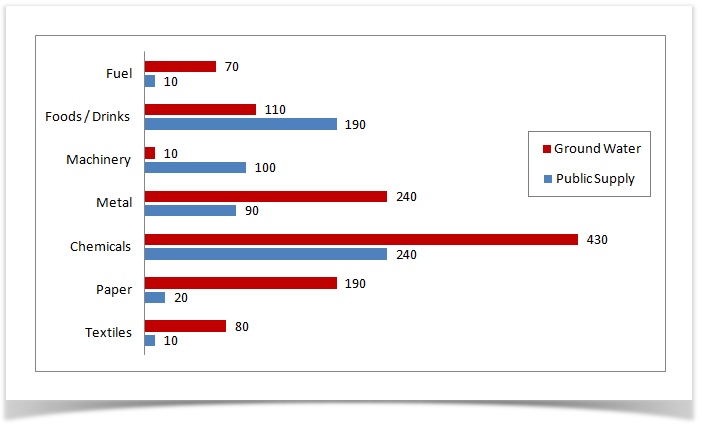
The graph below shows usual water usage (in millions of cubic meters) by industries in some countries in a year.
Sample Response
The supplied bar graph reveals the utilisation of water every year by different industries in several countries. The usage of water is categorised into two sources which are ground water and civic supply.
To begin with, some industries use the vast consumption of soil water in huge quantity. It starts from 430 million of cubic meters for chemicals as the highest consumption, and then it is followed by metal and paper which are 240m and 190m consumption respectively. Subsequently, other businesses also consume high figure of soil water than public supply namely fuel and textiles- both of it spend 80m and 70m in a row. Meanwhile, machinery industry has the lowest consumption of ground water which is just 10m.
There are, however, some businesses which prefer public supply than ground water. Food and drinks are the great deals on the usage of common supply water. The lowest consumption of public water comes from textile and fuel industries which are similar in number- 10m for both.
IELTS Writing Correction
- 1. Match the time frame Original: every year Suggested revision: in one year Why it matters: The chart presents usage for a single year rather than a recurring annual trend.
- 2. Use concise terminology Original: The usage of water Suggested revision: Water use Why it matters: Water use is the more concise and natural term in this context.
- 3. Name both sources accurately Original: which are ground water and civic supply Suggested revision: groundwater and public supply Why it matters: These are the two water-source labels represented in the chart.
- 4. Correct the quantity phrase Original: use the vast consumption of soil water in huge quantity Suggested revision: use large quantities of groundwater Why it matters: Industries use quantities of groundwater rather than use a consumption.
- 5. Remove incorrect preposition Original: 430 million of cubic meters Suggested revision: 430 million cubic metres Why it matters: Of is not used between million and the measurement unit.
- 6. Clarify the highest figure Original: for chemicals as the highest consumption Suggested revision: for the chemical industry, the highest figure Why it matters: The revision identifies the chart category and appositively labels its value.
- 7. Report figures grammatically Original: which are 240m and 190m consumption respectively Suggested revision: at 240 and 190 million cubic metres, respectively Why it matters: The revision supplies the correct unit and grammatical structure for the two values.
- 8. Use the chart category Original: businesses Suggested revision: industries Why it matters: Industries is the consistent term for the sectors compared in the chart.
- 9. Use a countable quantity Original: consume high figure Suggested revision: consume larger amounts Why it matters: Amounts can be consumed, whereas consume a figure is not grammatical here.
- 10. Complete the comparison Original: of soil water than public supply Suggested revision: of groundwater than of public-supply water Why it matters: The repeated preposition creates a clear comparison between the two sources.
- 11. Fix pronoun and verb Original: both of it spend Suggested revision: these industries use Why it matters: The plural industries require a plural reference, and use is appropriate for water.
- 12. Correct the category order Original: 80m and 70m in a row Suggested revision: 70 and 80 million cubic metres, respectively Why it matters: Fuel uses 70 million cubic metres of groundwater and textiles use 80 million.
Suggested Rewrites
- every year in one year
- The usage of water Water use
- which are ground water and civic supply groundwater and public supply
- use the vast consumption of soil water in huge quantity use large quantities of groundwater
- 430 million of cubic meters 430 million cubic metres
- for chemicals as the highest consumption for the chemical industry, the highest figure
Why this response received Band 5.5
The response has a sensible structure that groups industries by water source and includes several correct groundwater figures. However, it lacks a clear overview, reverses the fuel and textile figures, incorrectly identifies food and drinks as the largest public-supply user, and omits several important public-supply values. Prioritise an accurate overview and compare the two sources using standard terminology before adding selected supporting data.
IELTS Writing Criteria Scores
Task Achievement
Several groundwater figures are correctly reported, but the absence of an overview, a wrong public-supply maximum, and substantial omissions limit task coverage.
State that chemicals use the most of both sources, then include their 240-million public supply and accurate fuel and textile groundwater figures of 70 and 80 million.
Coherence and Cohesion
Paragraphs separate the introduction, groundwater, and public supply, creating basic progression despite incomplete comparisons.
Add a dedicated overview and organise each detail paragraph around clear high-low comparisons rather than a list of industries.
Lexical Resource
Some relevant vocabulary is attempted, but frequent misuse of terms such as 'soil water', 'civic supply', and 'spend water' reduces precision.
Use 'groundwater', 'public-supply water', 'consume', 'amount', and 'million cubic metres' consistently.
Grammatical Range and Accuracy
Frequent errors in articles, comparison forms, agreement, pronouns, and noun phrases make many sentences awkward, though the general meaning remains understandable.
Build simpler accurate sentences such as 'The chemicals industry consumed 430 million cubic metres of groundwater, followed by metal at 240 million'.
Write this task while it is fresh
Try the same task now. It helps you remember the feedback and write better next time.
IELTS Academic Writing Task 1
The graph below shows usual water usage (in millions of cubic meters) by industries in some countries in a year.
Your response
Write the task yourself, then compare your choices with the annotated response.