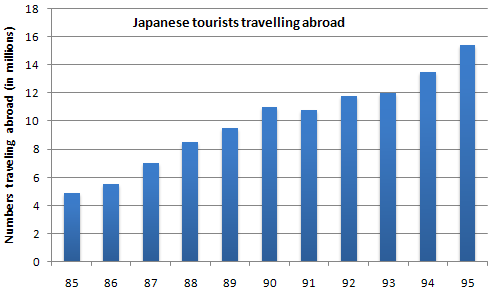
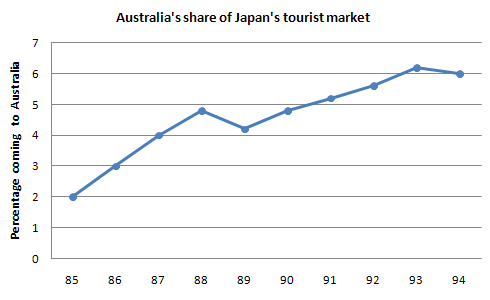
The charts below show the number of Japanese tourists travelling abroad between 1985 and 1995 and Australia's share of the Japanese tourist market.
Sample Response
The bar chart outlines how many Japanese travelled overseas between 1985 and 1995 while the line graph delineates the percentages of these tourists who visited Australia in particular between 1985 and 1994. Overall, the number of Japanese who made overseas travels soared and this is also true for the Australia visiting travelers from Japan. As can be seen from the illustration, around 5 million Japanese citizens travelled different countries in 1985 which kept on increasing each year except in 1991. From approximately 7 million tourists in 1987, it went as high as 12 million in just 6 years. Finally, in 1995, around 15 million Japanese toured foreign countries which was three times higher than that of a decade earlier. The line graph shows that 2% Japanese tourists reached Australia in 1985 and with a steady increase this figure went as high as roughly 5% in 1988. The next year the ratio slightly dipped but went higher each year in the subsequent years. Australia received more than 6% Japanese travellers in 1993, the highest, which stood at exactly 6% in 1994.
IELTS Writing Correction
- 1. Use natural verb phrase Original: made overseas travels Suggested revision: travelled overseas Why it matters: “Travelled overseas” is the idiomatic way to describe this activity.
- 2. Repair noun phrase Original: Australia visiting travelers from Japan Suggested revision: Japanese visitors to Australia Why it matters: The original compound is awkward and does not express the visitor-destination relationship clearly.
- 3. Add destination preposition Original: travelled different countries Suggested revision: travelled to different countries Why it matters: The verb requires “to” before the destinations.
- 4. Clarify the reference Original: which kept on increasing Suggested revision: and this figure increased Why it matters: The original relative pronoun appears to refer to 1985 rather than the number of travellers.
- 5. Name the figure Original: From approximately 7 million tourists in 1987, it Suggested revision: From approximately 7 million in 1987, the figure Why it matters: The pronoun “it” lacks a clear grammatical referent.
- 6. State ratio accurately Original: three times higher than that of Suggested revision: three times the figure from Why it matters: “Three times higher” is ambiguous when the intended comparison is a threefold total.
- 7. Add percentage preposition Original: 2% Japanese tourists Suggested revision: 2% of Japanese tourists Why it matters: A percentage must be linked to the group with “of.”
- 8. Use visit verb Original: reached Suggested revision: visited Why it matters: The graph measures tourists visiting Australia, not merely reaching the country.
- 9. Use concise measure Original: delineates the percentages Suggested revision: shows the percentage Why it matters: A single percentage measure varying over time is clearer and more concise here.
- 10. Remove redundancy Original: visited Australia in particular Suggested revision: visited Australia Why it matters: Naming Australia already makes the destination specific, so “in particular” adds no useful meaning.
- 11. Use measured trend language Original: soared Suggested revision: rose substantially Why it matters: The replacement describes the strong overall increase in a more neutral academic register.
- 12. Refer to both charts Original: illustration Suggested revision: charts Why it matters: The task contains two separate visuals, so the plural reference is more accurate.
Suggested Rewrites
- made overseas travels travelled overseas
- Australia visiting travelers from Japan Japanese visitors to Australia
- travelled different countries travelled to different countries
- which kept on increasing and this figure increased
- From approximately 7 million tourists in 1987, it From approximately 7 million in 1987, the figure
- three times higher than that of three times the figure from
Why this response received Band 7.0
The response provides a clear overview and selects accurate, well-chosen figures from both charts, including the temporary dips and the strong overall rises. Its main weakness is presentation in one unbroken paragraph, compounded by several awkward collocations and missing prepositions. The most valuable improvement would be to separate the two datasets into distinct body paragraphs and refine expressions for proportions and overseas travel.
IELTS Writing Criteria Scores
Task Achievement
A clear overview and accurate, well-selected data cover both charts and highlight their principal rises and temporary declines.
Strengthen the synthesis by explicitly linking the expanding outbound total with Australia's increasing market share.
Coherence and Cohesion
Ideas progress logically from the overview to each chart, but the absence of paragraph breaks makes the response less effectively organized.
Use a separate body paragraph for each chart while keeping the overview distinct from supporting figures.
Lexical Resource
A good range of trend language is used with some precision, although several travel and proportion collocations are awkward.
Refine expressions such as "travelled to different countries," "Japanese visitors to Australia," and "the proportion of tourists."
Grammatical Range and Accuracy
Varied complex sentences are generally well controlled, with occasional missing prepositions, unclear reference, and article errors that do not impede meaning.
Check noun phrases after percentages and ensure relative clauses have clear referents and complete prepositional patterns.
Write this task while it is fresh
Try the same task now. It helps you remember the feedback and write better next time.
IELTS Academic Writing Task 1
The charts below show the number of Japanese tourists travelling abroad between 1985 and 1995 and Australia's share of the Japanese tourist market.
Your response
Write the task yourself, then compare your choices with the annotated response.